
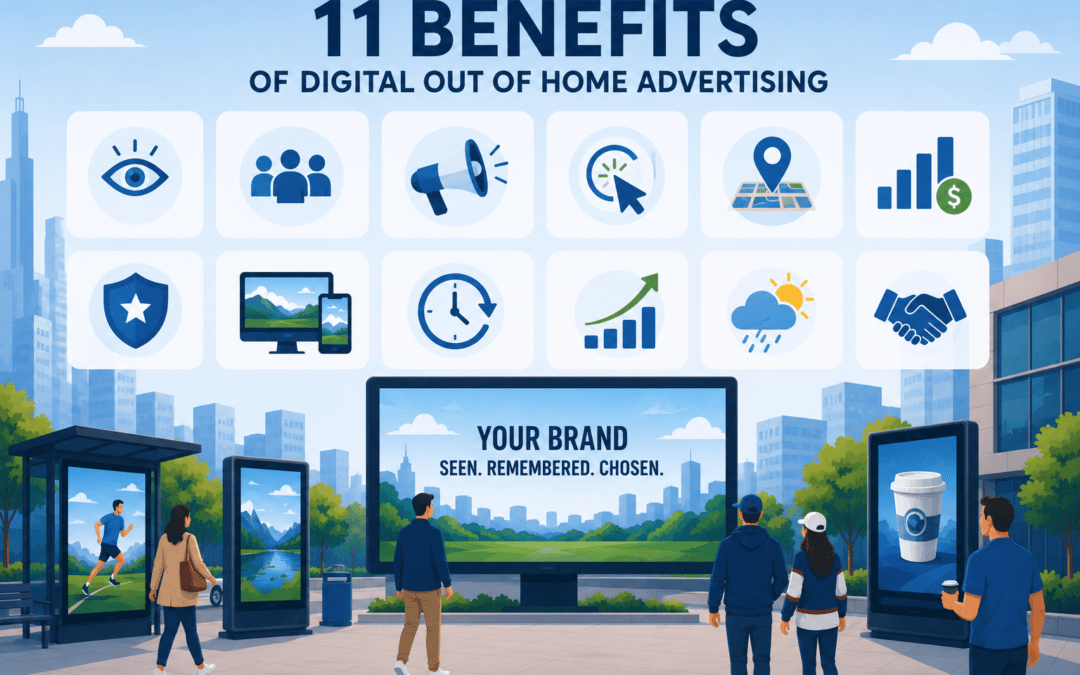
The screen in a community rink does something a social feed rarely can – it holds the room without asking for a click. That is the real starting point for understanding the benefits of digital out of home advertising. It reaches people when they are physically present, contextually engaged, and spending meaningful time in an environment they chose to be in.
For marketers, that changes the value equation. You are not fighting thumb-scroll behavior, skipped pre-roll, or banner blindness. You are showing up in places where families gather, athletes train, spectators wait, and communities return week after week. For venue operators, the same channel can turn underused wall space into recurring revenue without creating another operational burden.
Why the benefits of digital out of home advertising are different
Not all impressions carry the same weight. A roadside board may deliver scale but only a few seconds of glance time. A mobile ad may be targetable but easy to ignore. Digital out of home sits in a different lane because it combines visibility with dwell time.
That matters most in high-attention environments. In sports facilities, recreation centers, and private clubs, people are not simply passing through. They are arriving early, staying for games or practices, waiting on family members, socializing, and repeating that behavior every week. The media is experienced inside participation, not beside it.
That is why the best DOOH environments do more than display a message. They place the brand inside lived routine. When a message is seen repeatedly in a trusted community setting, it tends to feel less interruptive and more relevant.
1. Stronger real-world attention
The first and most important benefit is attention quality. Digital out of home advertising appears in physical spaces where audiences are more likely to actually notice it. Full-screen video in a waiting area, lobby, concourse, or lounge has more time to land than a six-second skipped ad or a display unit buried between headlines.
This does not mean every venue performs equally well. Attention depends on screen placement, dwell time, foot traffic patterns, and whether the environment encourages people to look up. But when the network is built around high-dwell community locations, the conditions are much stronger than most low-attention media.
2. Contextual relevance that improves recall
People respond differently to messaging when it appears in an environment that makes sense. A sports drink in a training facility, a healthcare provider in a family recreation center, or a financial brand in a private club setting all benefit from context. The message feels connected to the moment.
That kind of alignment can lift recall because the setting helps frame the brand. Instead of interrupting unrelated content, the ad becomes part of a real-world experience. This is one of the most overlooked benefits of digital out of home advertising. Context is not just a creative bonus. It is a planning advantage.
3. Frequency built through behavior, not just media pressure
A lot of media frequency is bought the hard way. You keep spending to re-find the same person across fragmented channels. Community-based DOOH works differently. It often earns repeat exposure because people return to the same facilities as part of their actual lives.
Parents come back for practices. Players return for games. Members revisit clubs weekly. That repeat behavior creates a natural frequency loop. The brand is seen again and again, not because the audience is being chased, but because the environment is part of their routine.
This is especially valuable for local businesses, franchise groups, and regional advertisers that want to stay visible in the communities they serve. Repetition in familiar places can build memory faster than broad reach in disposable contexts.
4. Local relevance at real scale
One of the biggest planning problems today is that local media has thinned out while local buying needs have not. Brands still need to show up in specific communities. They just have fewer effective ways to do it.
Digital out of home fills that gap. A local business can run in one market, one cluster of venues, or one neighborhood-adjacent environment. A national advertiser can activate across multiple regions while keeping the creative relevant to each community. That combination of local precision and scalable delivery is hard to replicate elsewhere.
For brands trying to balance national consistency with regional execution, this is where DOOH becomes the missing and complementary layer in planning.
5. Trusted environments improve brand perception
Where a message appears affects how it is received. Community sports and recreation spaces carry a level of trust because they are tied to participation, family routine, wellness, and local identity. That does not guarantee instant brand lift, but it creates a healthier starting point than many cluttered digital environments.
There is also less adjacency risk. A brand message on a venue screen is not sitting next to polarizing comments, low-quality content, or a chaotic feed. For advertisers that care about reputation, that control matters.
The effect is subtle but commercial. Brands often benefit when they show up in places that feel useful, familiar, and socially grounded.
6. Video creative works harder offline
Many marketers already have video assets. Digital out of home gives those assets another job to do. Instead of living only in online placements, video can extend into physical environments where the screen is larger, the setting is more stable, and the audience is less distracted by multitasking.
This is not just about repurposing content to save production costs, although that helps. It is about extending video into lived experience. A strong 10- or 15-second spot can take on new value when it plays in a venue where the viewer is present, alert, and not one tap away from moving on.
Of course, creative still needs to fit the format. Simpler messaging, stronger branding, and visual clarity tend to perform better than dialogue-heavy edits. The point is not to copy-paste digital creative blindly. The point is that video can travel well when the environment supports attention.
7. Better complement to other media channels
DOOH is rarely the whole plan, and it does not need to be. Its strength is often as an amplifier. It can reinforce paid social, extend mobile campaigns into the real world, support retail activity, and give sponsorship programs more presence between events.
That cross-channel role matters because people do not live inside media plans. They move between screens, places, and routines. When a brand appears both online and in the physical spaces someone visits every week, the message tends to feel bigger and more established.
For media buyers, this means DOOH can increase the effectiveness of channels already in play. For local advertisers, it can provide a visible anchor that makes the rest of the campaign feel more credible.
8. Flexible scheduling and creative updates
Traditional static placements can be slow to change. Digital out of home gives advertisers more agility. Campaigns can be updated by season, promotion, event calendar, audience segment, or geography without replacing physical materials.
That flexibility is useful for both national and local campaigns. A franchise can swap in market-specific creative. A seasonal business can shift messaging quickly. A brand with multiple offers can test which message fits which environment.
The trade-off is that flexibility only creates value if there is a clear strategy behind it. Constantly changing creative without a reason can weaken recall. The smartest use of DOOH combines agility with disciplined message planning.
9. Measurable exposure in physical environments
Offline media has long been judged as less measurable than digital, but that gap has narrowed. Today, advertisers can evaluate DOOH using venue traffic, dwell time, screen counts, campaign duration, and estimated impressions based on real-world visitation patterns.
That is not the same as last-click attribution, and it should not pretend to be. But for brands that understand upper- and mid-funnel media, these signals are meaningful. They show how often a campaign was likely seen, in what type of environment, and by what kind of audience behavior.
For many marketers, this is a more honest measurement model than inflated digital metrics that say a message was served but reveal little about whether it was truly seen.
10. Revenue without operational drag for venues
For venue operators, the benefits of digital out of home advertising are not limited to audience engagement. There is also a clear business case. Screens can create recurring revenue from existing space, which is especially attractive in facilities balancing high operating costs and limited funding sources.
The model works best when the operator does not have to become a media company to benefit from it. If installation, campaign management, sales execution, and support are handled by the network, the venue gains incremental income without adding internal complexity.
That matters for arenas, multi-sport facilities, recreation centers, and clubs that want commercial upside but do not have time to manage advertisers, creatives, and screen infrastructure on their own.
11. It reaches people where participation happens
The strongest benefit may be the simplest one. This channel places brands in environments where real life is actively happening. Not passive content consumption. Not background browsing. Participation.
That distinction is strategic. People build habits, loyalties, and purchase intent in the places that shape their routines. Community environments are where families spend time together, where kids develop interests, where adults maintain lifestyle patterns, and where local businesses can become familiar before they are ever actively researched.
That is why networks like Sports Digital Network are built around high-dwell venues rather than generic screen inventory. The media works harder when the environment means something.
The smart question is not whether digital out of home replaces every other channel. It is whether your current plan includes enough real-world attention. For many brands and venue partners, that is exactly where the next layer of value starts.