
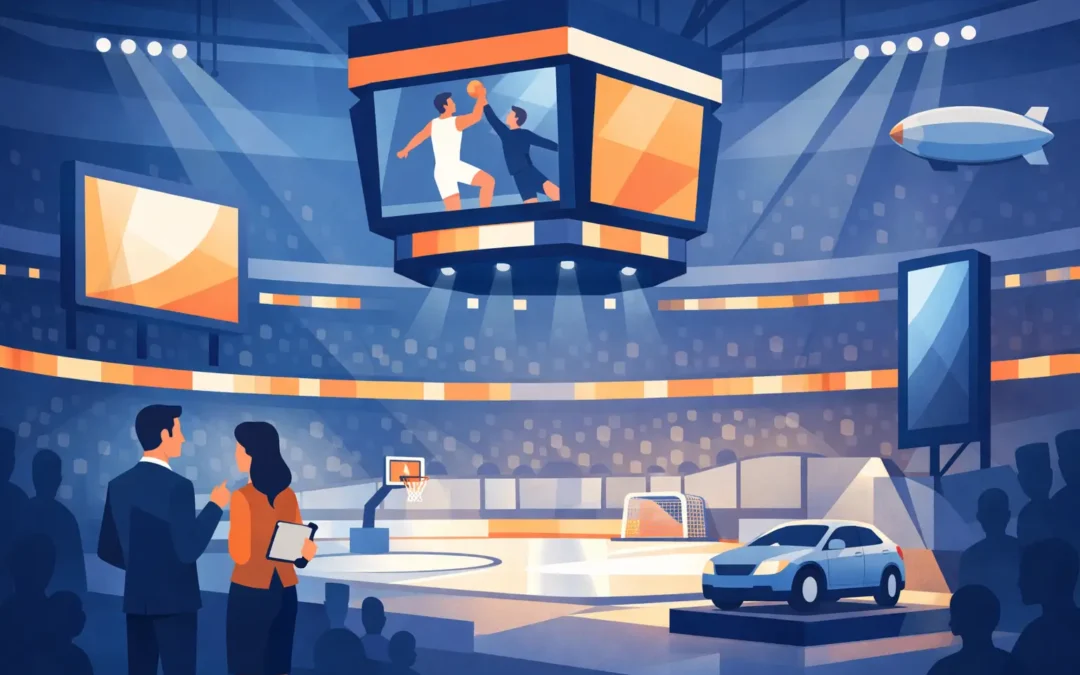
A parent is waiting for practice to end. A local hockey game is running late. A weekend tournament has families in the building for hours. That is where arena advertising opportunities stand apart. You are not trying to interrupt someone mid-scroll or catch them in a two-second roadside glance. You are showing up in a real place where people stay, return, and pay attention.
For advertisers, that changes the value of the impression. For venue operators, it changes the economics of the wall space. Arenas are not just community hubs. They are high-frequency media environments with built-in dwell time, recurring foot traffic, and audiences that are often hard to reach through traditional local channels.
Why arena advertising opportunities work
The case for arena media is simple. Attention is stronger when people are physically present, less distracted by competing screens, and spending 90 minutes or more on site. That is common in arenas, recreation facilities, and multi-sport complexes, where visitors arrive early, stay through games or practices, and return week after week.
That repeat exposure matters. One impression rarely does the full job for a local business or national brand. Most campaigns need frequency before they create recall, lift consideration, or drive action. Arena advertising opportunities naturally support that because the same audience often comes back multiple times each week across an entire season.
There is also a trust factor. Arena environments are deeply local. Families, athletes, coaches, and active adults see the same businesses and brands in the places that matter to their routines. That can make the message feel more relevant than a broad local media buy that reaches everyone and resonates with fewer people.
The audience inside an arena is more valuable than it looks
Arenas attract more than players. They bring in parents, spectators, league organizers, coaches, facility staff, and tournament visitors. In many markets, that audience includes households with steady discretionary spending, strong community ties, and regular purchasing needs. Think restaurants, auto dealers, healthcare providers, retail, real estate, financial services, home services, and family entertainment.
For national advertisers, the value is slightly different. Arenas can help build local presence at scale while keeping the environment premium and contextually aligned with active lifestyles, youth sports, and community participation. That is useful if a brand wants more than reach. It wants quality reach.
Not every arena audience is the same, and that is where planning matters. A suburban hockey facility, a municipal rec center, and a private sports complex will each produce different traffic patterns and consumer profiles. The opportunity gets stronger when media placement matches the behavior of the people actually using the venue.
What brands can buy through arena advertising opportunities
The best arena inventory is visible, digital, and designed for repeat impact. Full-screen video placements on prominent wall-mounted displays tend to outperform static formats because they command more attention and allow for motion, rotation, and campaign flexibility.
That flexibility matters for both local and national campaigns. A local orthodontist might want consistent weekly visibility tied to neighborhood families. A restaurant chain may want to rotate seasonal offers. A national CPG brand may prefer broad market presence with brand-led creative rather than direct response messaging. Digital placements make those adjustments easier without the production delays that come with printed signage.
Placement strategy also affects performance. Screens near entrances, concession areas, waiting zones, and high-traffic circulation paths usually deliver the strongest value because they capture people during natural pauses. That said, the right screen depends on the goal. If the campaign is built for awareness, broad exposure is the priority. If it is meant to influence a nearby action, proximity to exit paths or common gathering areas can matter more.
Arena advertising opportunities for local businesses
Local advertisers often get the clearest upside because the venue audience overlaps directly with their customer base. A family dentist does not need citywide mass reach if the right households are already spending hours each week inside nearby sports facilities. A local restaurant does not need to win every diner in the market. It needs to stay top of mind with families deciding where to eat after a game.
This is where arena media becomes more efficient than many legacy local channels. Radio can be broad but passive. Social can be targeted but crowded. Search captures intent but only when demand already exists. Arena advertising opportunities sit earlier in the decision process. They keep the brand visible in a place where routines are formed and buying decisions often happen later that day.
The creative can stay simple. A strong logo, a clear offer, a short message, and a relevant visual usually beat overloaded layouts. In high-dwell environments, repetition does the heavy lifting. The ad does not need to say everything at once. It needs to be remembered.
What national brands gain from arena media
National media teams are often under pressure to prove that local presence still scales. Arena networks offer one of the cleaner answers. They create distributed reach across multiple venues while preserving consistency in format, reporting, and execution.
That makes arena advertising opportunities attractive for regional rollouts, sponsorship extensions, retail support, and community-focused brand campaigns. A national advertiser can show up in environments that feel credible and rooted in daily life, rather than relying only on impressions delivered in fragmented digital spaces.
The trade-off is that arena media is not designed to replace every other channel. It works best as part of a broader media mix, especially when the goal is to improve recall, reinforce a message seen elsewhere, or add real-world frequency to a campaign that already includes digital and social. The value is not just in isolated exposure. It is in the lift that comes from showing up offline where people actually spend time.
Arena advertising opportunities for venue partners
From the venue side, the business case is straightforward. High-traffic wall space can become a recurring revenue stream without forcing operators to build an in-house media business. That matters because most arena owners and managers are not trying to become ad tech companies. They want a practical way to monetize foot traffic while keeping the facility modern and professionally managed.
Digital signage makes that possible, but only if the model is operationally simple. Installation, content management, sales, reporting, and advertiser servicing all require time and expertise. A partner model removes that burden and turns underused visual space into monthly revenue.
There is also a guest experience benefit when screens are professionally deployed. Clean, well-placed digital displays can make a facility feel more current while serving both commercial and informational functions. Poorly managed signage can clutter the building. Professionally managed media can add value without making the venue feel over-commercialized.
That balance matters. Venue partners need revenue, but they also need to protect the community feel of the space. The right network operator understands that and builds inventory that supports the environment rather than overwhelming it.
How to evaluate arena advertising opportunities
Not all arena media is equal. Buyers should look beyond the phrase itself and ask better questions. How long do visitors stay? How often do they return? Where are the screens placed? Is the inventory digital or static? Can the network deliver multiple venues with consistent execution? Is there a credible method for estimating impressions based on traffic and dwell time?
For local advertisers, the first filter should be audience fit. If the venue draws the same households you want to reach, the medium has a shot. If not, no amount of signage quality fixes that. For national buyers, the bigger question is network scale and operational consistency across markets.
Venue operators should ask a different set of questions. How much management work stays on your team? Who handles sales? Who owns the hardware? How is revenue structured? What standards are in place for creative quality and advertiser category control? A good media partnership should feel additive, not distracting.
One company that has built its model around that logic is Sports Digital Network, with a focus on placing full-screen digital advertising in high-dwell sports and recreation environments. The pitch is simple because the environment is simple: strong attention, repeat exposure, and real-world relevance.
Why this channel is getting harder to ignore
Media buyers are dealing with the same problem across markets. Audiences are fragmented, digital attention is expensive, and too many impressions pass by without being noticed. Arena advertising opportunities answer that problem with a more grounded form of visibility.
They are not built on interruption. They are built on presence. Brands show up in the rhythm of community life, in places people return to, with the kind of frequency that actually creates memory. Venue operators, meanwhile, gain a revenue stream tied to traffic they already have.
The smartest media decisions are not always about chasing the newest format. Sometimes they come from putting the message where the audience is already staying put.