
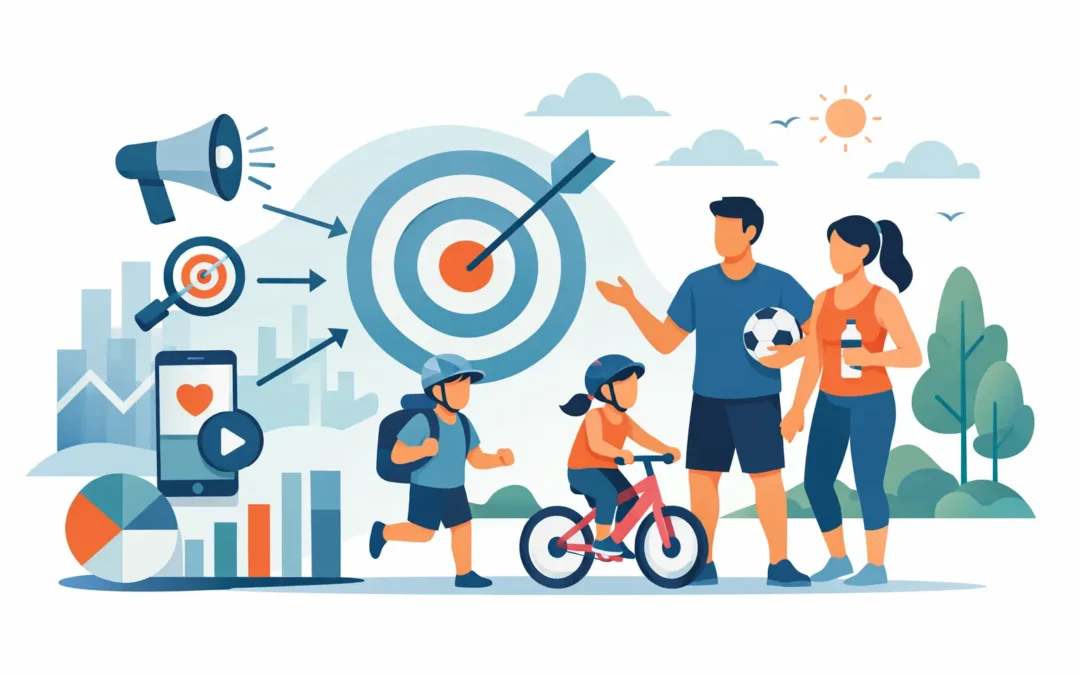
Saturday at 8:12 a.m. tells you more about family behavior than most media dashboards ever will. One parent is tying skates, another is carrying a coffee and a gear bag, siblings are moving between the lobby and the rink, and everyone is already thinking about the next stop. If you want to understand how to reach active families, start there – inside the rhythm of their week, not inside a targeting menu.
Active families are not hard to find. They are hard to catch with the right level of attention. Their schedules are full, their media habits are fragmented, and their standards are high. They move between school, sports, fitness, errands, and family time, often in the same day. That makes them valuable, but it also means many traditional channels reach them in rushed, low-attention moments.
Why active families are different to reach
This audience lives in motion, but not in chaos. Their routines are structured. Weekly practices, lessons, games, tournaments, and recreation visits create repeated behavior patterns that are far more predictable than they first appear.
That matters because predictability changes media strategy. You are not trying to interrupt random scrolling. You are trying to show up consistently inside places and moments that families already trust. A message seen during a recurring real-world routine lands differently than one squeezed between social posts or skipped before a video starts.
There is also a contextual layer that many advertisers miss. Active families are not just consumers of products and services. They are participants in a lifestyle built around health, development, convenience, performance, and community. The setting changes the message. An ad for quick-service dining, healthcare, home services, insurance, vehicles, financial planning, youth programs, or retail can all make sense here – but only if the environment supports the relevance.
How to reach active families by following behavior
The simplest answer to how to reach active families is this: plan around where family participation happens repeatedly.
That sounds obvious, but most campaigns still overinvest in channels built around passive consumption. Families may see those ads, but seeing is not the same as registering. Attention quality matters. In high-dwell community environments like arenas, multisport facilities, and recreation centers, families are present for extended periods, often 90 minutes or more, and they come back week after week.
That repeat exposure is not a minor detail. Frequency built through real behavior is often stronger than frequency bought through impression volume alone. If a parent sees your brand every Tuesday and Thursday at the rink for three months, that familiarity compounds. It feels local. It feels established. It feels like part of the environment they already rely on.
This is where place-based media has an advantage. It aligns with lived routine instead of chasing borrowed attention.
The environments that actually matter
Not every family environment delivers the same value. If your goal is broad family reach, some locations create more commercial relevance than others.
Arenas and recreation centers work because they combine dwell time, repetition, and multigenerational presence. You are not reaching one person in isolation. You are reaching parents, kids, grandparents, coaches, and other household decision-makers in a shared setting. That creates social reinforcement around the message.
Multisport facilities are especially strong for brands that want to connect with performance-minded households. These audiences often index higher for spending related to wellness, food, apparel, transportation, and family services. Private clubs and premium recreation venues introduce a different profile – often more affluent, more established, and more likely to respond to brands positioned around quality and trust.
The trade-off is scale versus specificity. A broad family campaign may need a wider venue mix. A premium or localized campaign may perform better with fewer, better-aligned environments. The right answer depends on whether you need market coverage, household quality, or both.
Messaging for active families has to respect the moment
Families in motion do not have patience for vague brand theater. They respond to clarity, relevance, and timing.
That does not mean every ad needs a hard offer. It means the message should quickly answer a real question: why does this matter to me or my family right now? The strongest creative in these environments tends to be visually clean, easy to process at a glance, and grounded in practical value.
For local businesses, that may mean convenience, location, trust, or a family-friendly offer. For national brands, it may mean product relevance tied to performance, nutrition, finance, mobility, healthcare, or everyday household decisions. In either case, the context is doing part of the work. The environment already signals activity, community, and routine. Your creative should build on that, not fight it.
Video is particularly effective here because motion attracts attention in a static environment. But creative discipline still matters. If the screen is carrying the message, keep the story simple. One idea. One benefit. One reason to remember the brand later.
Reach is stronger when local relevance is visible
One of the biggest mistakes in family marketing is assuming broad demographic fit is enough. It is not. Families are highly responsive to signals that a brand understands their actual community.
That can show up in different ways. A local provider can emphasize proximity and familiarity. A regional brand can use market-specific creative or neighborhood-level promotions. A national advertiser can win by appearing in the places where community life is visibly happening, rather than relying only on generalized digital reach.
This is why local relevance at scale matters. A campaign can be national in planning and still feel grounded in real neighborhoods. That balance is often missing from media plans. Brands buy reach, but they do not always buy presence.
Presence matters because active families make decisions in context. They are comparing options on the go, discussing plans in the lobby, and mentally organizing the week while waiting for practice to end. If your brand appears in that setting consistently, it earns a different kind of credibility.
Measurement should match the medium
If you are evaluating how to reach active families, use metrics that reflect real-world exposure, not just digital habits.
Impressions still matter. So do venue counts, audience profiles, dwell time, and weekly frequency. But the bigger strategic question is whether the channel creates stronger attention than the alternatives. A lower-volume campaign in a trusted, high-attention environment can outperform a larger campaign delivered in distracted settings.
This is where advertisers need to be honest about what they are buying. Cheap reach is not efficient if the audience barely registers the message. High repetition is not valuable if the environment encourages skipping, scrolling, or tuning out. Attention is different inside spaces where people are physically present, behaviorally anchored, and returning by routine.
For many brands, the smart move is not replacing digital or traditional out-of-home entirely. It is adding the missing layer that improves the plan. Community venue media can amplify sponsorship, extend video into lived experience, and give brands a stronger foothold in family behavior.
When this strategy works best
This approach is especially effective for brands that benefit from trust, repeated exposure, and household influence. Healthcare, food and beverage, financial services, automotive, retail, telecom, education, home services, and family entertainment all have a clear fit.
It is also well suited to franchise groups and multilocation businesses that need market-level visibility without losing neighborhood relevance. For those advertisers, a network model creates efficiency while keeping the audience grounded in real places.
That said, context still matters. If your offer is highly niche or requires deep consideration before purchase, venue media may work better as a reinforcement channel than a standalone driver. If your brand depends on immediate click-through, this is not the same game. The value here is attention, memory, and repeated real-world presence.
What brands get wrong about active family media
The biggest mistake is thinking family audiences are best reached through family content. Often, they are better reached through family routines.
Content targeting can help, but it misses the physical environments where decisions, conversations, and habits actually form. Families do not live inside audience segments. They live in movement, participation, and recurring community spaces.
That is why modern media planning needs a stronger real-world layer. Digital can build efficiency. Social can support relevance. Search can capture intent. But if you want to influence active households before the moment of transaction, you need presence where their week actually happens.
Networks like Arena Advertising are built around that logic: not more media clutter, but better placement inside high-attention community environments where families return again and again.
The best family strategy is usually not louder. It is more grounded. Show up where participation is already happening, make the message easy to absorb, and let consistency do what interruption rarely can.