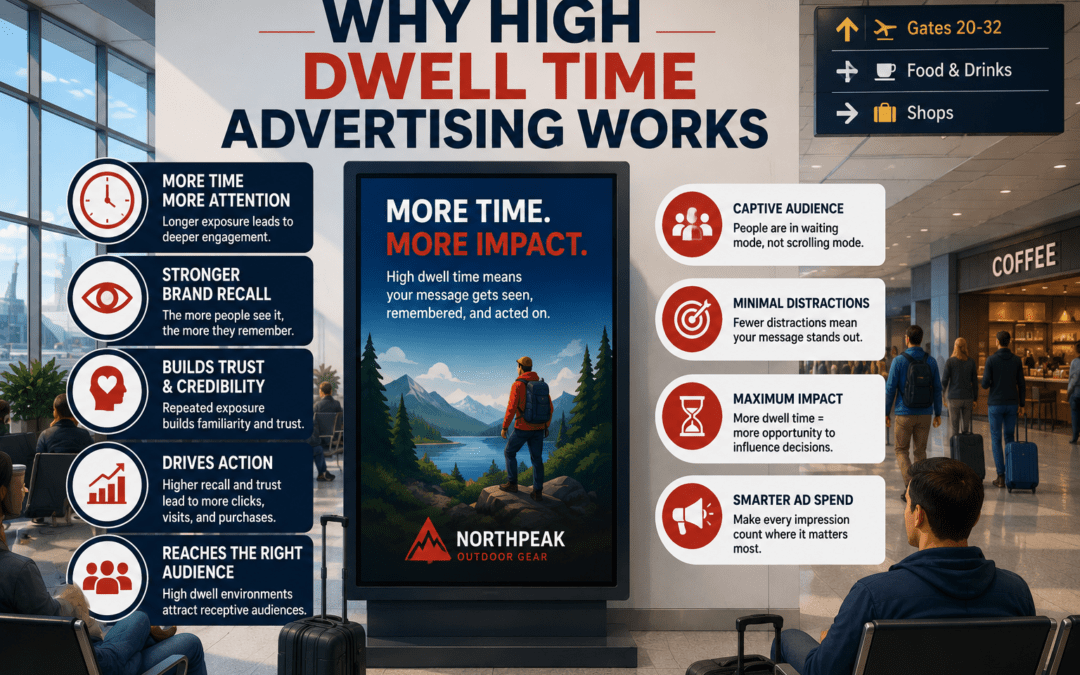
What high dwell time advertising actually means
High dwell time advertising refers to media placed in environments where audiences remain on site for extended periods of time. Not seconds. Often 60, 90, or 120 minutes at a stretch. In sports facilities, arenas, recreation centers, and private clubs, people are not just passing through. They are waiting, participating, watching, socializing, and returning week after week.
That changes the value of every impression. A screen seen repeatedly during a single visit lands differently than a message squeezed into a fast-moving feed. A brand shown in a trusted physical setting, surrounded by real activity and community participation, tends to feel more credible than one fighting for space in an overloaded digital environment.
This is why dwell time is not just a venue metric. It is an attention metric.
Attention quality is the real product
Media buyers are under pressure to prove reach, but reach without attention is a weak outcome. If a campaign generates impressions that are technically delivered but barely processed, the reporting can look fine while the business result stays flat.
High dwell time advertising is stronger because it improves attention quality. People have more opportunities to notice the creative, understand the message, and remember the brand. They are also often in a more settled frame of mind. At an arena concourse, a community sports complex, or a golf clubhouse, the audience is not actively trying to avoid advertising. They are present. They are waiting. They are looking around.
That does not mean every ad suddenly becomes effective. Creative still matters. Placement still matters. Repetition can help or hurt depending on execution. But the baseline media condition is better. Instead of fighting distraction at maximum intensity, the brand appears in a real-world environment where people have the time and mental space to actually take it in.
Why context makes high dwell time advertising more persuasive
The strongest media environments do more than hold attention. They shape meaning.
A message shown inside a sports or recreation setting benefits from context. These venues are associated with effort, routine, family life, achievement, wellness, and community participation. That makes them especially valuable for categories tied to health, finance, automotive, food, retail, insurance, telecom, and local services. The ad is not floating in a vacuum. It is being seen in a place that already carries emotional and behavioral relevance.
This is one reason place-based media often outperforms generic local advertising. It reaches people where they are engaged in actual life, not just consuming content. For brands, that can create a better fit between message and moment.
There is a trade-off, of course. Contextual media is not always the right channel for every objective. If the goal is immediate click-through or direct-response volume at scale, a performance platform may be more efficient. But if the goal is brand visibility, local market presence, frequency among valuable audiences, or extending video into lived experience, high dwell time environments offer something most digital channels cannot.
Repetition works differently when people return
A lot of media frequency is accidental. The same user gets hit with the same ad because the platform optimization says so. That can generate waste fast.
In high dwell time advertising, frequency is often behavior-driven. The same parent comes back every Tuesday and Thursday. The same adult rec league player shows up each week. The same member visits the club multiple times a month. Repetition is built into real-life routine, which gives the media a more natural pattern.
That matters because memory is built through exposure over time, especially when the environment is consistent. A local dental clinic, quick-service restaurant, auto dealer, or telecom provider can become familiar simply by showing up in the places people regularly inhabit. National brands benefit too. Community-based frequency can turn broad awareness into something more grounded and more local.
This is where modern out-of-home planning becomes more strategic. It is not just about posting a logo in a venue. It is about understanding how repeated exposure inside trusted environments can move a brand from recognition to consideration.
Trusted places produce a different kind of brand impression
Not all impressions are equal because not all environments are equal.
A sports facility or recreation center is not just high traffic. It is a trusted place tied to habits, schedules, and family life. People bring their kids there. They spend hours there. They often know the space well and associate it with community value. Advertising inside that environment benefits from that trust, especially compared with channels where misinformation, clutter, and low-quality content have trained audiences to tune out.
That does not mean the venue itself transfers credibility automatically. Brands still need to show up appropriately. Creative should be clean, confident, and easy to absorb at a glance. Messaging should match the environment rather than overpower it. But when the fit is right, the effect is hard to ignore. The ad feels present, not invasive.
Why this matters for local and national advertisers
Local media has become fragmented to the point of inefficiency in many markets. Community attention did not disappear, but many of the channels that once organized it did. That has left advertisers trying to rebuild local relevance through a mix of paid social, search, radio, and scattered sponsorships.
High dwell time advertising offers a more direct route into community presence. For local businesses, it can create familiarity in the exact environments where nearby customers spend time each week. For regional and national brands, it provides local relevance at scale. The same network logic can run across multiple markets while still feeling grounded in place.
That balance is one of the biggest strategic advantages. Brands do not have to choose between national consistency and neighborhood credibility. They can have both if the network is built around real-world behavior.
For advertisers, this makes place-based video especially useful as a complementary layer in planning. It can amplify sponsorship, extend campaign creative beyond mobile and CTV, and add an offline attention channel that is simple to activate but difficult to ignore. For a media mix that feels increasingly abstract, that physical presence has real value.
High dwell time advertising is not just for advertisers
Venue operators should look at this category differently too.
If you manage an arena, multi-sport complex, recreation facility, or private club, your walls already hold attention. The question is whether that attention is being monetized in a way that matches the value of the environment. Static signage often underperforms because it is hard to update, hard to sell consistently, and easy for visitors to stop noticing.
Digital screens change that. They create recurring inventory, keep content fresh, and allow a venue to generate revenue without turning the facility into a cluttered ad space. The model works best when the media operator handles installation, sales, campaign management, and network execution. That lowers the operational burden for the venue while turning underused wall space into a more predictable revenue stream.
This is where a network like SDN fits well. The value is not simply screens on walls. It is packaging real-world attention in places where participation happens, then making that attention usable for both advertisers and venue partners.
What brands should get right before they buy
The case for high dwell time advertising is strong, but smart planning still matters.
First, match the venue to the audience. A family-focused brand may perform well in recreation centers and arenas, while a premium service may fit better in private clubs. Second, respect the pace of the environment. Creative should be built for quick comprehension, not dense reading. Third, think in terms of frequency and market presence, not one-off novelty. The real advantage comes from repeated exposure in places people return to.
Finally, judge performance by the right criteria. This channel is not trying to win on clicks. It is trying to improve visibility, recall, and brand presence in the real world. For many categories, that is not a secondary benefit. It is the main job.
Media works better when it fits how people actually move through life. And if your audience is spending 90 minutes in the same place, week after week, that is not a gap in the plan. It is probably the part worth paying closest attention to.