
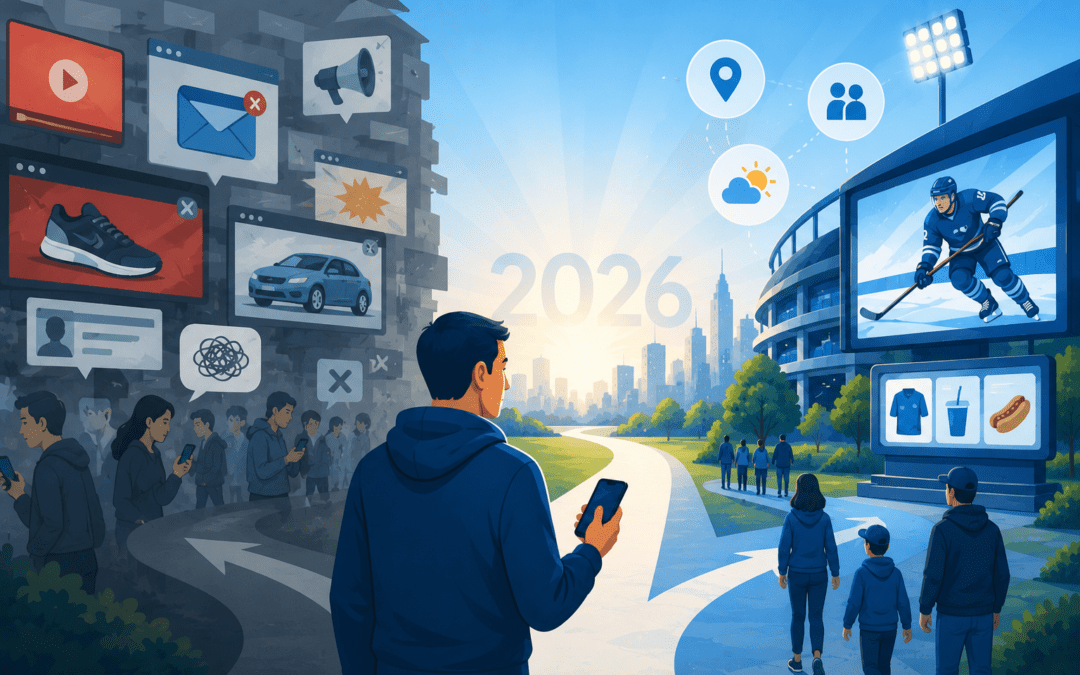
The media problem heading into 2026 is not a lack of targeting. It is a lack of meaning. When marketers start exploring why contextual advertising may matter more than audience targeting in 2026, the answer is increasingly practical: audience targeting has become commoditized, media fragmentation has weakened many digital impressions, and real-world context is doing more of the heavy lifting.
For years, audience targeting was treated like the smart layer in media. Find the right person, follow them across platforms, optimize toward conversion, and let the machine work. That logic still has value. But once every platform, DSP, retailer, and data provider offers some version of the same audience segments, targeting stops being a strategic advantage. It becomes table stakes.
That shift matters because media plans still need differentiation. If everyone can buy parents, sports fans, high-income households, auto intenders, or frequent travelers, then the question changes. It is no longer just who you reached. It is where you reached them, what mindset they were in, how much attention was available, and whether the environment added credibility to the message.
Why audience targeting has become commoditized
Audience targeting used to feel scarce. Better data meant better access, and better access meant a real advantage. That gap has narrowed fast. Major platforms now package audiences in familiar, repeatable ways. Clean rooms, modeled segments, retail media taxonomies, first-party data partnerships, and lookalike tools have made targeting widely available, even when signal quality varies.
The result is a market where many advertisers are buying versions of the same audience at the same time. That drives up cost, reduces distinctiveness, and often creates false precision. A buyer may know they reached a likely sports parent or active adult, but that does not tell them whether the ad landed in a useful moment. It does not tell them whether the placement felt relevant. And it definitely does not tell them whether the consumer had the time or mental space to notice.
This is where marketers often overestimate the value of identity and underestimate the value of setting. A targeted impression inside a cluttered feed, beside low-quality content, or in a distracted scroll is still a weak impression. Good audience data cannot fully rescue poor media conditions.
There is also a practical planning issue. As targeting becomes standardized, brands lose some of the asymmetry that once made performance channels feel special. More advertisers have access to similar tools, similar segments, and similar optimization systems. That makes it harder to build a durable edge through targeting alone.
Media fragmentation has reduced the value of many impressions
Reach has not disappeared. Attention has.
Consumers now move constantly between streaming, social, gaming, retail media, audio, connected TV, messaging, and live experiences. That creates more touchpoints, but not necessarily more impact. Many digital impressions are technically delivered and strategically forgettable.
Fragmentation has changed the economics of media quality. Brands can buy scale, but scale often arrives in pieces – partial views, skipped placements, muted autoplay, background tabs, short exposure windows, and contexts that people barely register. On paper, impressions still accumulate. In practice, many of them do very little.
This is one reason more marketers are reassessing the role of environment in campaign effectiveness. Not every impression deserves equal value. A full-screen message seen repeatedly in a high-dwell venue is not the same as an impression served into a distracted mobile session. A brand seen while someone is actively participating in community life has a different weight than one seen while they are swiping past ten other messages in under a minute.
That difference becomes even more important when frequency is considered. Digital media can produce frequency cheaply, but it often produces low-quality repetition. Real-world media can produce behavior-driven frequency instead – the kind that comes from recurring routines, weekly attendance, seasonal participation, and trusted community settings. Those exposures may be fewer in count, but stronger in effect.
Why contextual advertising may matter more in 2026
Contextual relevance is not just about matching an ad to content. In 2026, it is better understood as matching a message to a moment, a behavior, and an environment.
That broader view matters because people do not live inside audience segments. They live inside routines. They drop kids at hockey practice. They spend 90 minutes inside recreation centers. They gather at arenas, training facilities, and golf clubs. They return to the same places week after week. These environments are not random backdrops. They shape attention, mood, receptivity, and recall.
When a brand shows up in a setting that already aligns with the consumer’s activity, the media works harder. Relevance feels more natural. The message borrows trust from the environment. The impression is less interruptive because it fits the experience rather than fighting it.
That is the missing piece in a lot of digital planning. Audience targeting tells you who a person might be. Context helps explain what they are doing, what they care about in that moment, and how open they may be to brand messaging.
Media environments influence how brands are perceived
The surrounding environment changes the meaning of the ad itself. This has always been true, but it becomes more valuable as generic targeting scales.
A brand seen inside a well-used community sports venue benefits from a very different set of signals than a brand served in a low-trust digital environment. One is associated with participation, movement, family routines, local identity, and time well spent. The other may simply be another interruption inside a crowded media feed.
That distinction matters for both local and national advertisers. A local service provider wants to appear embedded in the community, not dropped into it. A national brand wants reach, but it also wants to feel present in real life, not just present in media. Contextual media environments can do both by creating local relevance at scale.
This is especially useful for brands trying to extend sponsorship or video strategy into lived experience. The venue itself becomes part of the communication system. The screen delivers the message, but the environment gives it weight.
Consumer behavior is making context more valuable
Consumer behavior is moving in two directions at once. People are harder to reach consistently in personal media, yet highly reachable in recurring real-world routines. That tension is why context is gaining ground.
In fragmented digital channels, consumers skip, swipe, mute, multitask, and split attention across devices. In high-dwell physical environments, the conditions are different. People wait, watch, participate, socialize, and return. These are slower, more stable moments. That creates better conditions for memory and brand association.
This does not mean digital stops mattering. It means digital is often stronger when complemented by contextual real-world exposure. A consumer may first see a video ad on connected TV or social, then encounter the same brand message in a sports facility they visit every week. That second exposure can validate the first. It can move the brand from passive media consumption into physical presence.
For planners, that creates a more useful way to think about channel roles. Audience targeting can help identify likely buyers. Contextual environments can improve how the message is experienced. The strongest plans are not audience versus context. They are audience plus context, with context carrying more strategic importance than many plans currently give it.
Real-world attention is harder to fake
One of the biggest issues in modern media is that reporting has become richer while actual attention has become thinner. Marketers can optimize dashboards endlessly, but optimization does not always mean real engagement.
Real-world media is different because exposure happens in a physical setting with actual dwell time, repeat visitation, and visible presence. That does not solve every measurement challenge, but it does solve something more basic: the ad had a real chance to be seen.
For brands trying to break through, that matters. Advertising where your audience actually lives, gathers, and participates creates a stronger foundation than buying more cheap impressions in more fragmented channels. The quality of attention is not a soft metric. It affects recall, brand trust, and response.
That is why contextual advertising may matter more than audience targeting in 2026. Not because targeting disappears, but because targeting without meaningful context is becoming easier to buy and harder to differentiate. The real advantage is shifting toward media that understands behavior, environment, and moment.
For advertisers, that means asking better questions in planning. Not just who is the audience, but where are they spending real time? What settings signal trust? Which environments create repeat exposure without fatigue? And where does the brand appear as part of community participation rather than as another interruption?
For venue operators, it means the walls inside high-traffic spaces are not just infrastructure. They are media assets inside environments that already command attention. That is increasingly valuable in a market where attention is scarce, community is durable, and context is doing more of the work.
In Canada, networks such as SDN are built around exactly that shift: extending video into lived experience in places where attention is different. As 2026 planning takes shape, that is less a niche idea and more a media correction. The smartest impressions may not be the most targeted ones. They may be the ones that make the most sense where people are actually living their lives.
Estimated reading time: 8 minutes