
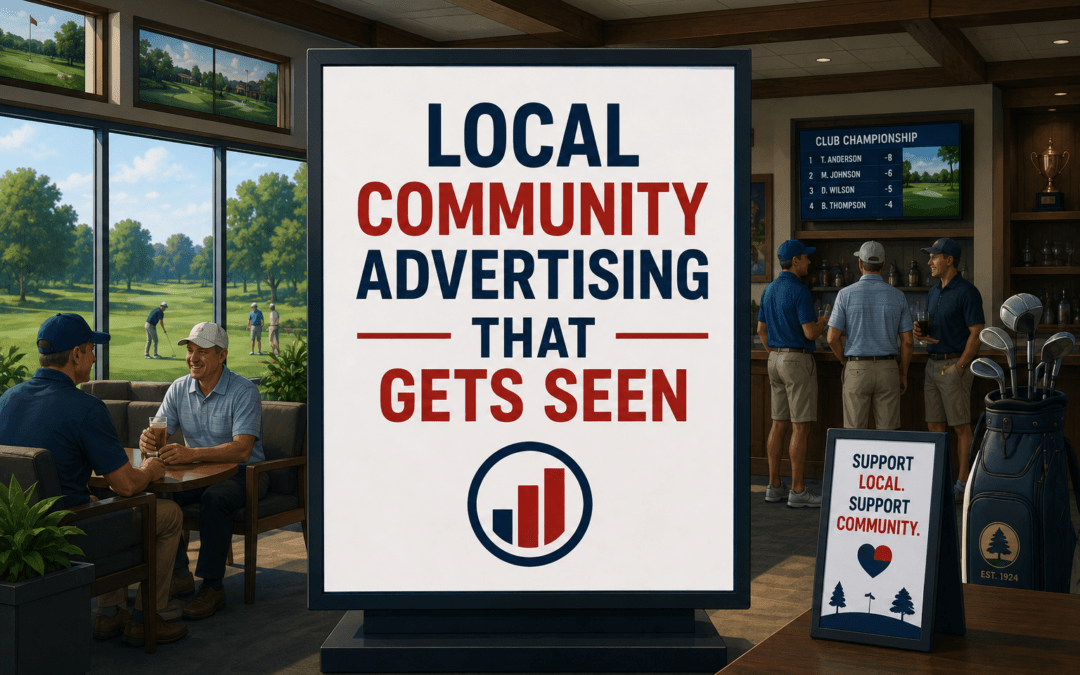
Most local ads are easy to ignore. They sit beside ten other messages, get skipped in seconds, or flash past people who are already focused on something else. Local community advertising works differently because it shows up where people are physically present, emotionally engaged, and part of a routine.
That difference matters more than ever. Local media options have fragmented, social feeds are crowded, and even strong creative can disappear when the environment is wrong. If a brand wants to stay visible in a market, the question is no longer just how many impressions it can buy. It is whether those impressions happen in a setting where people are likely to notice, remember, and act.
What local community advertising actually means
Local community advertising is brand messaging placed inside the real-world spaces people use every week – arenas, recreation centres, multi-sport facilities, clubs, schools, and other shared environments tied to daily life. These are not anonymous traffic channels. They are places with familiarity, repetition, and trust built in.
That changes the role of media. In a community setting, advertising is not interrupting entertainment or fighting for a split second of attention at 60 miles per hour. It is embedded in an environment where people wait, watch, participate, and return. Parents sit through practices. Athletes arrive early. Families spend entire evenings at a facility. Golf members visit repeatedly across a season. Attention is different here because behavior is different here.
For advertisers, this creates a media layer that many plans are missing. For venue operators, it creates a practical way to monetize wall space and audience traffic without turning the facility into a cluttered ad zone.
Why attention is stronger in community environments
The case for community advertising is not nostalgia. It is media logic.
People remember messages better when the surrounding environment is trusted, familiar, and relevant. A screen inside a recreation centre or rink benefits from all three. The venue already has purpose. The audience has chosen to be there. And the dwell time is long enough for repeated exposure to do its job.
This is where local campaigns often outperform their budget. A community venue may not look massive on paper compared with broad-reach digital media, but its attention quality can be significantly higher. Someone who sees a full-screen message multiple times during a 90-minute visit is not engaging with that brand the same way they would engage with a banner ad that loads below the fold.
Frequency also behaves differently in these spaces. Instead of manufactured retargeting, you get routine-based repetition. The same family may visit the same arena three times a week. The same adult league player may return every Tuesday. The same member may walk through the same club lobby all season. That kind of recurring exposure builds familiarity in a way many local channels no longer can.
Where local community advertising performs best
Not every community setting delivers equal value. The best environments combine dwell time, repeat visitation, and a reason for people to pay attention to their surroundings.
Arenas and multi-sport facilities are especially strong because they bring together families, athletes, coaches, and spectators in one place for extended periods. Recreation centres add another layer, often reaching broad local audiences across age groups and household types. Private golf clubs offer a different profile – often affluent, routine-driven, and highly place-based.
The context matters just as much as the audience count. A healthcare clinic, home services company, financial advisor, auto dealer, restaurant group, or national CPG brand can all benefit from local community environments, but the fit depends on whether the venue aligns with the consumer moment. Advertising beside participation often carries more weight than advertising beside passive consumption.
That is one reason place-based video has become more important. It extends brand messaging into lived experience rather than leaving it confined to mobile and desktop environments.
What advertisers should look for in a local community media buy
A local community advertising plan should not be judged only by CPM. That is where many buyers make the wrong comparison.
The better questions are simpler. How long are people on site? How often do they come back? Is the environment trusted? Does the venue match the audience you actually want to reach? And does the format give the creative enough presence to be noticed?
Full-screen video placements tend to outperform static clutter in these settings because they command more visual attention and are easier to absorb from a distance. That does not mean every screen network is valuable. Poor screen placement, low-quality venues, weak loop design, or oversold inventory can reduce effectiveness quickly.
Buyers should look for four things:
- consistent dwell time and repeat visitation
- venue types that reflect real consumer behavior
- creative formats built for visibility, not just presence
- reporting that connects exposure to actual foot traffic and audience patterns
The strongest networks are not just selling screens. They are selling context, frequency, and real-world attention.
Local relevance at a national scale
This is where community advertising becomes especially useful for larger brands and franchise groups.
National campaigns often struggle with local credibility. They can buy reach, but they do not always feel present in the communities they serve. Local community advertising closes that gap by placing national messaging inside familiar venues where participation happens. A brand stops feeling distant and starts feeling active in the places people already value.
For franchise operators and multi-location businesses, this is even more practical. They can show up market by market in a way that feels tailored without rebuilding the entire media strategy from scratch. The message can stay consistent, while the venue mix brings local relevance.
That balance is hard to find in other channels. Hyperlocal digital targeting can look precise, but the environment often lacks trust or attention. Traditional local media can provide presence, but not always behavioral alignment. Community-based place media can do both when planned properly.
The creative rules are different here
Many advertisers make the mistake of repurposing social creative and expecting it to work in a physical venue. Usually, it does not.
Community-based screens are viewed in motion, from varying distances, and often without sound. The message needs to land fast. Branding should appear early. The offer or value proposition should be clear in seconds. And the visual hierarchy needs to be clean enough to read in a real environment, not just on a laptop preview.
This does not mean the creative has to be simplistic. It means it has to respect the venue. Strong place-based creative feels native to the environment while still standing out. A youth sports venue can support energetic family-oriented messaging. A golf club may call for a more refined tone. The audience is not just local. It is situational.
The strongest campaigns also understand that community advertising often works as an amplifier rather than a standalone tactic. It reinforces sponsorships, extends digital video into the real world, and adds physical presence to campaigns that otherwise live entirely on screens people carry in their pockets.
What venue partners gain from local community advertising
For facility owners and operators, this is not only an advertising conversation. It is a revenue and experience conversation.
High-traffic venues already hold audience value. The issue is execution. Most operators do not want to source hardware, manage ad sales, maintain content loops, or chase local advertisers. They want a model that creates recurring income without adding operational friction.
That is why managed network partnerships are gaining traction. When installation, sales, scheduling, and support are handled externally, venues can monetize existing wall space while keeping the environment professional. Done well, the screens feel additive rather than intrusive.
There is also a broader benefit. Relevant advertiser presence can strengthen the local business ecosystem around a venue. A physiotherapy clinic, restaurant, youth program, automotive dealer, or financial service provider can all become more visible to the exact community already using the facility. The advertising stays close to where community participation is happening.
The trade-offs buyers should be honest about
Community advertising is powerful, but it is not universal.
If a campaign needs instant scale across the entire country in a matter of days, community venue media may work best as a complementary layer rather than the lead channel. If the product has no logical connection to the venue audience, exposure alone will not fix that. And if creative is poorly adapted for physical screens, even premium attention can be wasted.
But those are planning questions, not flaws in the channel. The real advantage of local community advertising is that it solves a growing problem in modern media: too many impressions happen in places people barely notice.
When brands appear inside trusted, high-dwell environments, they are not just buying space. They are buying a better chance to be remembered. That is why modern place-based networks, including Sports Digital Network, are increasingly valuable to advertisers who want local relevance without sacrificing strategic rigor.
Local media disappeared. Community did not. The brands that understand that will keep showing up where attention still has weight.