
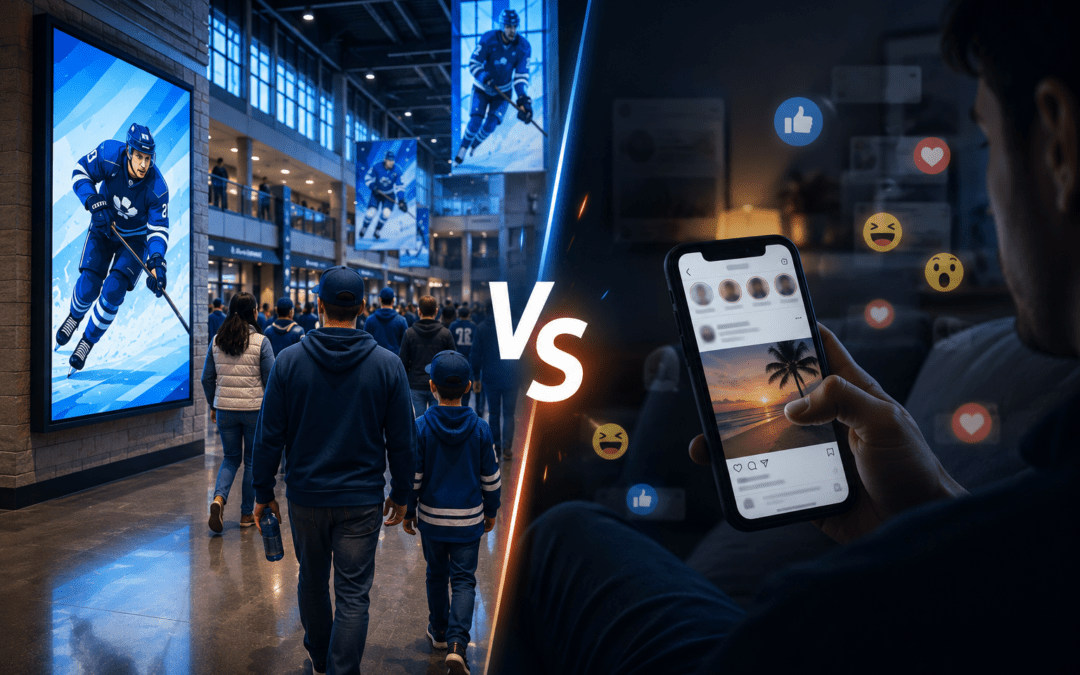
A family can spend 90 minutes at a rink, a golfer can stay on site for half a day, and a parent at a rec center may return every week. That is the real frame for place based media vs social. One channel meets people while they are physically present in a trusted environment. The other competes inside a feed built for speed, distraction, and constant interruption.
That does not make social weak. It makes the comparison more useful. If you are trying to decide where budget should go, the right question is not which channel is newer, cheaper, or easier to buy. It is which channel creates the kind of attention your brand actually needs.
Place based media vs social starts with attention
Most media planning still treats an impression like a flat unit. It is counted, priced, and stacked into a reach model. But attention is not flat. A six-second glance while someone scrolls past a post is not the same as repeated exposure on a full-screen display inside a venue where people stay, wait, watch, and return.
That is where place-based media changes the conversation. In high-dwell environments like sports facilities, recreation centers, and clubs, audiences are not just passing through. They are participating. They are waiting between games, gathering with family, watching from the sidelines, ordering food, checking schedules, and moving through common spaces multiple times. The ad is part of lived experience, not just a break inside content.
Social, by contrast, is built around fragmented attention. It can still perform, especially when creative is strong and targeting is smart. But it asks your message to survive thumb speed, feed fatigue, skipped video, and a crowded auction environment. If your category depends on memory, local familiarity, or repeated visual reinforcement, that is a real constraint.
The biggest difference is context
Social platforms know a lot about users. That is their strength. They can target interests, behaviors, and demographics with precision. For direct response, that matters. If you need quick conversion signals, retargeting, or campaign optimization at scale, social can be efficient.
But precision is not the same as relevance.
Place-based media works differently. It reaches people in a setting that already says something about who they are and what matters to them. A message inside an arena reaches families, athletes, coaches, and active community members while they are engaged in a routine they chose. A screen in a private golf club reaches an affluent audience in an environment associated with lifestyle, leisure, and social status. A campaign in a recreation facility reaches repeat visitors in a space tied to health, youth activity, and community trust.
That kind of contextual relevance is harder to fake online. You can target someone who likes fitness content on social. It is more powerful to reach them while they are actually inside a fitness-oriented environment.
Reach is where social still leads
If the goal is mass reach in a short window, social usually wins that round. It is fast to launch, easy to scale, and flexible across audiences and markets. National brands use it because it can generate volume quickly. Local businesses use it because it feels accessible.
That matters, but so does what happens after the ad appears.
A larger number of low-attention impressions does not always outperform a smaller number of high-attention exposures. This is especially true for brands that need familiarity before action. Home services, healthcare, automotive, financial services, education, restaurants, retail, and franchise brands often benefit from repeated visibility in community settings. Consumers may not click in the moment, but they remember who was present.
That is one reason place-based media often works well as the missing layer in planning. It does not replace social’s scale. It strengthens it by adding real-world repetition where people actually live their routines.
Social is fast. Place-based media is sticky.
Social is excellent at immediacy. You can promote a weekend offer, test creative in real time, and shift budget by geography or audience segment quickly. For product launches, event sign-ups, app installs, and e-commerce promotions, that flexibility is valuable.
Place-based media is different. Its advantage is not speed alone. It is stickiness.
When audiences see the same brand week after week in the same trusted environment, the message starts to feel familiar in a way that feeds rarely achieve. The brand becomes part of the local pattern. It is seen by the morning hockey crowd, the after-school families, the weekend tournament visitors, and the adults who return for league play. Frequency is driven by behavior, not just media pressure.
That kind of repetition is especially useful for businesses that want to own a local trade area over time. It also supports national brands that need local relevance without building separate campaigns for every neighborhood.
Place based media vs social on measurement
Measurement is often where marketers get stuck. Social offers dashboards, clicks, views, completion rates, and conversion tracking. Those metrics are easy to access and easy to compare. The problem is that they can create false confidence. A completed view is not the same as meaningful brand impact. A click is not the only signal that matters.
Place-based media is measured differently. The key inputs are venue traffic, dwell time, repeat visitation, screen placements, and estimated exposure over time. That may feel less immediate than a social reporting panel, but it reflects something important: real-world presence among a defined audience in a physical environment.
For many advertisers, the smarter question is not which channel has more metrics. It is which metrics connect to the business outcome. If you are driving online sales tomorrow, social may be easier to optimize. If you are building local awareness, consideration, and top-of-mind presence in a community, place-based media can deliver stronger media logic than a feed-only plan.
The creative rules are not the same
A lot of underperformance comes from using the same creative logic in both channels.
On social, creative has to interrupt fast. It often depends on motion in the first second, text overlays, direct hooks, and heavy testing. It lives inside a platform culture and has to adapt to it.
In place-based environments, the creative job is different. The screen is larger, the setting is more stable, and the audience is not necessarily holding a phone with sound on. Clear branding, simple messaging, strong visuals, and relevance to the venue context matter more than social-style noise. A local restaurant near the rink, a healthcare provider serving active families, or a national sports drink brand all benefit when the message feels native to the environment rather than forced into it.
When done well, place-based creative feels less like an interruption and more like a visible part of the venue experience.
So which one should get the budget?
The honest answer is that it depends on what the campaign needs to do.
If your priority is direct response, rapid testing, short-term traffic, or audience segmentation at scale, social deserves budget. If your priority is attention quality, trusted context, community visibility, and repeat exposure in high-dwell environments, place-based media has a stronger case.
For many brands, the best answer is not place based media vs social as a winner-take-all decision. It is sequencing and role clarity.
Use social to target, retarget, and convert. Use place-based media to establish presence, reinforce recall, and extend video into real-world routines. Social can tell people what to do next. Place-based media helps make sure they remember who you are when the decision moment arrives.
That balance is particularly strong for brands trying to reach families, active adults, and local communities that are harder to engage through traditional local media alone. People do not live inside media plans. They live in neighborhoods, facilities, clubs, and recurring routines. The channels that show up there carry a different kind of weight.
For venue operators, there is a second layer to this comparison. Social monetizes attention on someone else’s platform. Place-based media allows physical venues to create value from the attention they already generate every day. That is not just a media decision. It is a business model decision.
A smart media plan is rarely built on one channel. But it should be built on a clear understanding of what each channel is actually good at. Social gives you speed and scale. Place-based media gives you attention that holds, context that fits, and visibility inside environments where participation happens.
If your brand has been shouting into feeds and wondering why awareness still feels thin, the answer may not be more impressions. It may be better environments.
Estimated reading time: 7 minutes