
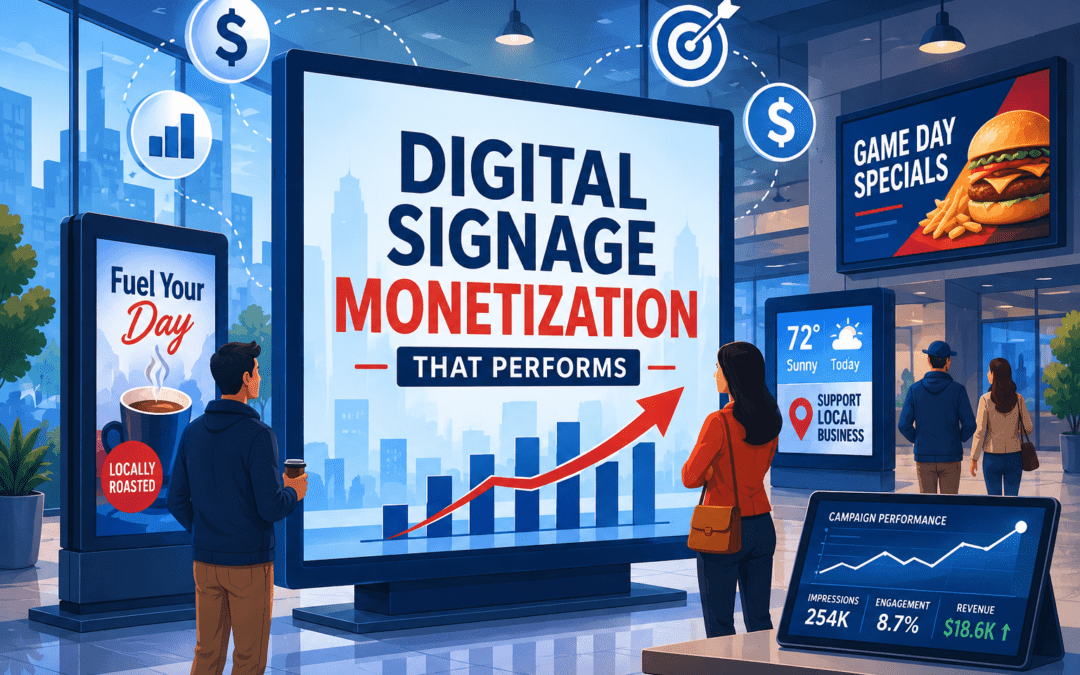
A screen on a wall is not a business model. Attention is.
That is the real starting point for digital signage monetization. Too many operators think revenue comes from the hardware itself, or from simply having foot traffic nearby. It does not. Revenue comes from placing messages in environments where people are present, receptive, and likely to see the screen more than once.
That distinction matters because not all impressions carry the same value. A screen in a busy but distracted setting may generate movement around it, but very little recall. A screen inside an arena, rec center, sports complex, or private club works differently. People are on site for longer stretches. They return regularly. They are not just passing through. They are participating.
What digital signage monetization actually means
At its most practical level, digital signage monetization is the process of turning screen space into recurring revenue. That can come from local advertisers, regional campaigns, national media budgets, sponsorship extensions, or a combination of all four.
But the stronger definition is more strategic. Monetization is not about selling pixels. It is about packaging real-world attention in a way advertisers can understand and buy. If the audience is right, the setting is trusted, and the message shows up at the right frequency, the screen stops being a utility and starts behaving like media.
For venue operators, that creates incremental monthly income from wall space that would otherwise sit idle. For advertisers, it offers access to high-attention environments that digital feeds and traditional local media often struggle to match.
Why some screens monetize and others do not
The market has no shortage of screens. What it lacks is quality inventory.
A monetizable screen usually has four things working in its favor. First, there is dwell time. People stay long enough to absorb motion-based creative instead of catching a one-second glance. Second, there is repeat visitation. Weekly leagues, practices, tournaments, lessons, and social routines create behavior-driven frequency. Third, there is contextual relevance. The message appears in a setting that feels connected to real life, not dropped into a cluttered stream. Fourth, there is trust. Community venues carry a different emotional tone than most ad environments.
When one of those factors is missing, revenue gets harder. A screen may still have value, but pricing power weakens. Advertisers can feel the difference between exposure and interruption, even if they do not phrase it that way.
This is why sports and recreation environments often outperform generic place-based inventory. They combine duration, routine, and participation. Families, athletes, active adults, and affluent club members are not just present. They are engaged in something that matters to them.
Digital signage monetization starts with audience quality
Media buyers are under pressure to justify spend. Local business owners feel it too. They are not looking for more impressions in theory. They want visibility that lands in the real world, in places their customers actually spend time.
That is where audience quality changes the conversation. A screen inside a high-dwell community venue reaches people in a more grounded state of attention. They are waiting between games, watching a practice, checking schedules, grabbing food, socializing, or spending time with their kids. The environment is active, but it is not chaotic in the way online media can be.
That makes the inventory easier to position. Instead of selling volume alone, you can sell presence, frequency, and local relevance. For national advertisers, that means reaching communities at scale without losing contextual fit. For local advertisers, it means showing up in the same places their customers already trust.
The best revenue model depends on who is selling
There is no single blueprint for digital signage monetization because the operational model matters.
If a venue operator owns and manages everything alone, they keep more direct control, but they also take on the hard parts: installation, content scheduling, sales outreach, reporting, and ongoing support. That can work for organizations with a dedicated commercial team, but many facilities do not want a side business in media operations.
A partner-led model changes that equation. The venue contributes the physical environment and the audience access. The media network handles execution, sales, creative rotation, and advertiser management. Revenue is shared, but so is the burden. For many operators, that trade-off is worth it because passive screen ownership is not the goal. Predictable monthly income is.
From the advertiser side, a managed network is often easier to buy. It provides standardized formats, campaign coordination across multiple venues, and a clearer planning story. That matters when a buyer wants both local precision and broader regional reach.
Pricing digital signage inventory without underselling it
One of the most common mistakes in digital signage monetization is pricing based on the cost of the screen instead of the value of the audience.
Advertisers are not paying for the display panel. They are paying for repeated exposure in a setting that supports brand recall. A premium environment with strong dwell time should not be priced like generic lobby inventory just because both use digital screens.
That said, premium pricing has to be supported by a credible sales narrative. Buyers need to understand who is there, how often they return, how long they stay, and why the environment improves attention. If that story is vague, pricing becomes negotiable in the wrong direction.
The strongest approach usually blends local accessibility with network-level sophistication. Offer simple entry points for local businesses that want presence in one or two venues. At the same time, create packages for regional and national advertisers that want category exclusivity, multi-location reach, or video extension across community environments.
Creative matters more than most operators think
A monetized screen is only as strong as the advertising experience it delivers.
If the creative is cluttered, hard to read, or built for another channel, performance drops. That affects advertiser satisfaction and future renewal. Real-world screens need messages that are visually immediate. Short copy. Strong branding. Motion used with discipline. Clear relevance to the environment.
This is especially true in sports and recreation settings, where audiences are active and socially engaged. The ad does not need to shout. It needs to register quickly and feel at home in the venue.
The upside is that good creative often works harder in these environments than online. It is not trapped between endless competing tabs, notifications, and skip buttons. It gets a cleaner moment of attention.
Measurement should be practical, not performative
Not every advertiser needs the same level of reporting. A national brand team may want impression modeling, venue counts, campaign duration, and geographic coverage. A local business may simply want confidence that its message is showing up in the right place, consistently, in front of the right people.
The mistake is overcomplicating measurement to mimic digital ad-tech language. That can make a place-based network sound less credible, not more. Real-world media should be measured in ways that reflect how people actually move through space: visitation, dwell time, repeat exposure, and venue relevance.
This is one reason community-based networks have become more valuable. They offer something many media plans are missing – real-world frequency in trusted environments. Not passive consumption, but presence inside daily routines.
For advertisers, that can strengthen broader campaigns. For venue operators, it creates a clearer case for why their wall space deserves recurring media investment.
Where digital signage monetization works best
The strongest environments tend to share the same fundamentals: reliable traffic, long visits, repeat attendance, and a clear audience profile. Arenas, multisport facilities, rec centers, and private clubs check those boxes because they attract communities, not just crowds.
That difference is bigger than it sounds. Crowds are temporary. Communities come back.
When people return week after week, advertisers gain cumulative exposure. Messages start to build familiarity. Sponsorships extend into lived experience. The screen becomes part of the venue rhythm rather than a random interruption.
That is also why this model works for both local and national demand. A neighborhood restaurant, orthodontist, dealership, or home services company can use it to reach families close to the point of action. A larger brand can use the same network to build relevance market by market across Canada or the US, depending on footprint.
The real question is not whether to monetize
For most high-traffic venues, the more useful question is how to monetize without creating operational drag or diluting the guest experience.
The answer usually comes down to fit. Fit between the audience and the advertiser. Fit between the screen and the environment. Fit between revenue goals and execution capacity. Screens that respect those realities tend to perform commercially because they feel intentional, not forced.
That is where a modern network approach has an edge. It treats digital signage less like hardware and more like contextual media. For companies like SDN, that means turning community venues into high-attention advertising environments while giving operators a revenue stream they do not have to manage alone.
The opportunity is straightforward: if people are already gathering, staying, and returning, the wall should do more than fill space. It should work.
Estimated reading time: 7 minutes