
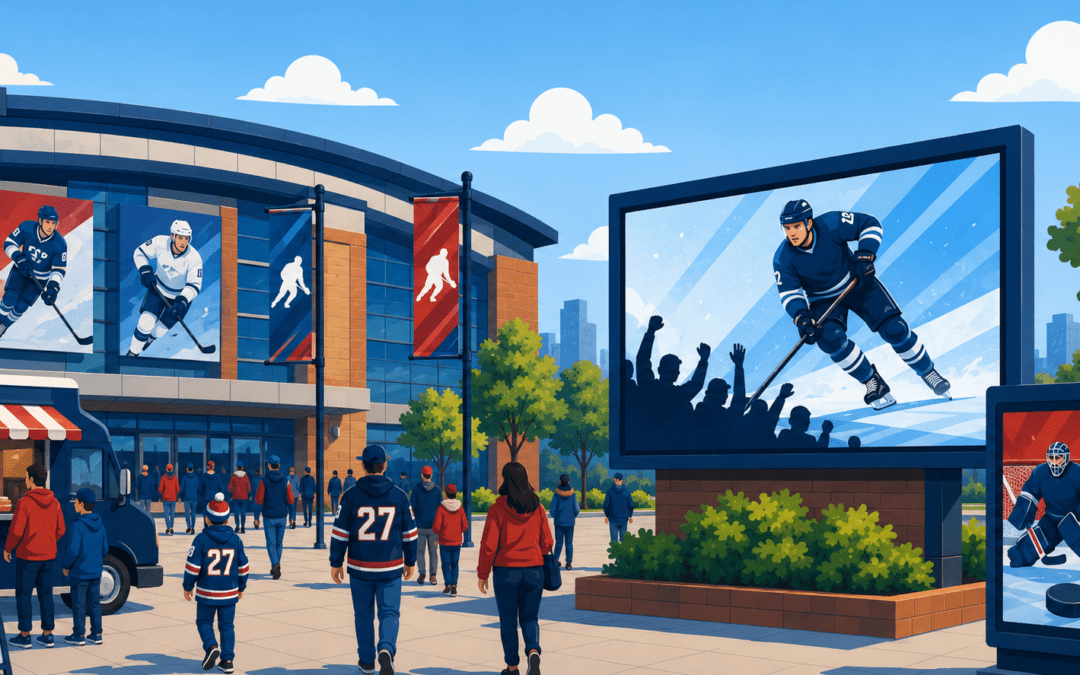
A parent is waiting through a 6:00 a.m. hockey practice. A club player is grabbing coffee between matches. A family is back at the same facility for the third time this week. That is why advertising in sports complexes deserves a different level of attention from marketers. These are not passing impressions. They are repeated exposures inside places people actively choose to be, often for 90 minutes or more.
For brands trying to reach families, active adults, community decision-makers, and high-frequency local audiences, sports complexes offer something many channels cannot – time, trust, and relevance in the same environment. The media logic is simple. When people are on site, engaged in real life, and not rushing past a message, attention quality changes.
Why advertising in sports complexes stands out
Most media channels fight for attention inside cluttered, distracted environments. Feeds are scrolled. Pre-roll is skipped. Roadside media gets a glance at best. Sports facilities operate differently. People arrive early, wait between activities, socialize in common areas, and return week after week.
That behavior matters more than raw impression volume. Media value is shaped by what the audience is doing when they see the message. In a sports complex, they are not just consuming media. They are participating in community life. That creates a stronger context for brand recall and a more credible setting for local and national advertisers alike.
There is also a practical planning advantage. Sports complexes fill a gap that many media plans leave open. Brands may invest in digital, social, streaming, radio, and outdoor, yet still miss the real-world moments where families and active consumers actually spend time together. This channel becomes the missing and complementary layer – one that extends video into lived experience.
The real value is dwell time, not just foot traffic
A busy venue is useful. A busy venue where people stay is far more valuable.
In sports complexes, dwell time is often the overlooked multiplier. A person attending a game, training session, swim lesson, tournament, or league night is usually not in and out in five minutes. They are waiting in lobbies, sitting in viewing areas, walking through common spaces, and returning to the same screens multiple times during a visit.
That changes how messages are absorbed. Full-screen video in a high-dwell environment has room to land. It can build familiarity instead of fighting for a split-second reaction. For local advertisers, that can mean stronger recognition among nearby families and repeat customers. For national brands, it can mean a more durable presence in community settings where purchase decisions are shaped over time, not just triggered online.
This is also where frequency becomes more meaningful. Repetition in a low-quality environment can feel like waste. Repetition in a trusted, real-world environment can build mental availability. The same parent may see a brand several times in one visit and then again next week. That is behavior-driven frequency, and it is hard to replicate in channels defined by fragmented attention.
Advertising in sports complexes reaches people in decision-making mode
Sports venues are community environments, but they are also decision environments.
Parents are choosing restaurants after practice. Families are booking summer camps. Athletes are shopping for gear, recovery services, healthcare providers, insurance, vehicles, and financial products. Adults in these spaces are often household planners, not passive viewers. They are managing schedules, budgets, activities, and local spending.
That makes context especially important. A message for a physiotherapy clinic, quick-service restaurant, automotive dealer, dental office, financial advisor, or retail brand can feel naturally connected to the moment. The environment adds relevance without forcing it.
This is one reason sports complex media works across both local and national campaigns. Local businesses benefit from proximity and familiarity. National advertisers benefit from appearing in trusted community settings that feel grounded, visible, and real. The scale may differ, but the strategic advantage is the same – better attention in a setting where daily life is happening.
Trusted environments change how brands are received
Not every impression carries the same emotional weight. A sports complex is tied to routine, development, community pride, and shared time. People associate these places with their kids, their teams, their progress, and their social circles. That emotional backdrop matters.
When a brand appears in that environment, it borrows some of the trust and stability of the setting. This does not mean every ad becomes instantly persuasive. It means the starting point is stronger than in channels where interruption is the defining experience.
There is a difference between showing up beside content people are trying to skip and showing up in a place they have chosen to spend their evening. One is passive consumption. The other is participation. That distinction is central to why place-based media inside sports facilities can outperform expectations, especially when the creative is clear, visually strong, and locally relevant.
What marketers get wrong about this channel
The biggest mistake is treating venue-based media like a niche add-on. It is not just a sponsorship extra or a filler line in a local plan. Used properly, it can function as a high-attention video extension that supports awareness, recall, and local credibility.
The second mistake is focusing only on event days or major tournaments. Those moments matter, but the weekly rhythm is often more valuable. Recurring practices, league play, lessons, and everyday facility usage create dependable exposure patterns. That consistency is what makes the channel useful for ongoing campaigns, not just seasonal bursts.
The third mistake is assuming all venues perform the same way. They do not. Audience mix, dwell time, traffic flow, screen placement, and facility type all influence outcomes. An arena serving families several nights a week is different from a private club with affluent adult members. A multisport complex with year-round programming offers a different media profile than a single-use venue. Smart planning starts with behavior, not just geography.
What venue operators should understand
For facility owners and operators, the case is not only about media. It is about monetizing space that already carries attention.
Many sports complexes have high-traffic walls, gathering areas, and viewing zones that are valuable but underused. Turning those areas into a managed digital media asset can create recurring revenue without asking staff to become media operators. That matters because most facilities do not want a side business in screen management, ad sales, scheduling, and support. They want a practical model that adds income without adding operational drag.
The strongest venue partnerships preserve the experience of the space while making the asset work harder. That means high-quality displays, thoughtful placement, professionally managed content, and a clear understanding of audience patterns. If the screens feel intrusive or poorly integrated, value drops. If they are placed where people naturally pause and look, value compounds.
This is where a network approach can make sense. Instead of selling one location in isolation, venues can become part of a broader footprint that gives advertisers both local relevance and multi-market scale. For operators, that can mean a more stable monetization path. For advertisers, it creates the rare combination of community specificity and broader reach.
How to think about sports complex media in a real plan
The best use of this channel is usually not either-or. It is additive.
For an advertiser, sports complex media can reinforce digital campaigns with physical-world frequency. It can support retail, service, franchise, or brand campaigns with contextual visibility near real consumers and real routines. It can also extend sponsorship into an environment where people actually spend time, rather than limiting brand presence to logos and event signage.
For a media buyer, the question is not whether these audiences can be found elsewhere. Of course they can. The better question is whether they can be reached elsewhere with the same combination of dwell time, repeat visitation, community trust, and reduced distraction. Often, the answer is no.
That is why this channel has become more relevant as other forms of local media have weakened. Local media disappeared. Community did not. People still gather in real places, on real schedules, with real habits. The brands that show up there gain more than exposure. They gain proximity to how people actually live.
If your audience spends its week in arenas, rec centers, multisport facilities, and clubs, your media plan should reflect that reality. Attention is different here, and smart brands are starting to plan for it.