
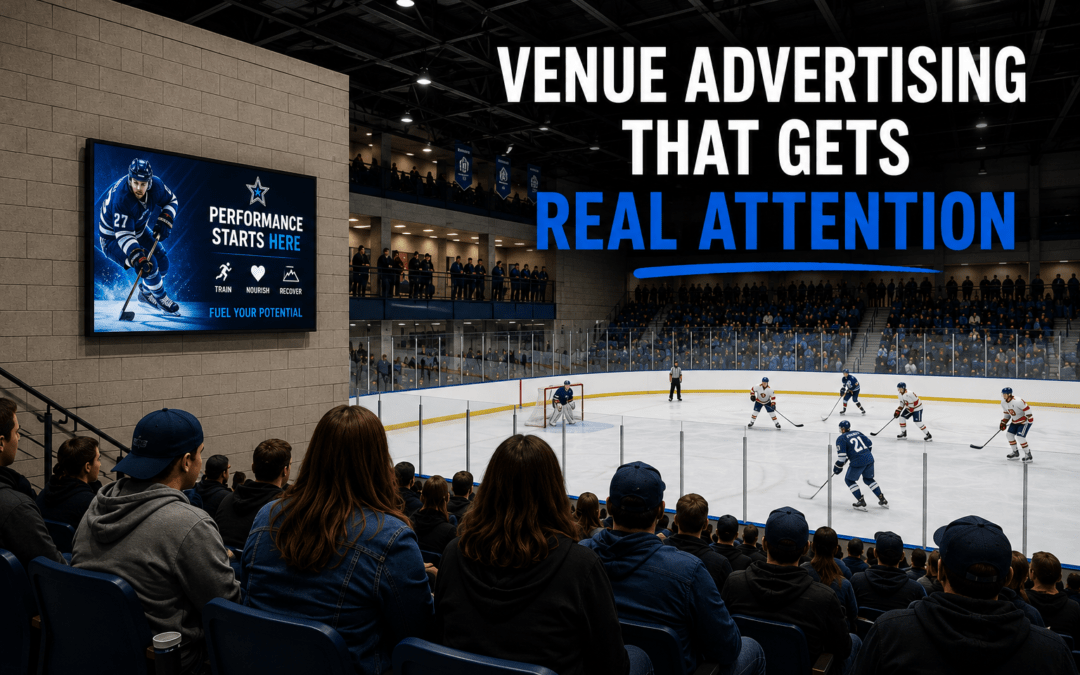
A family walks into the arena before dawn for a tournament game. Parents settle in for hours. Players move between ice, hallways, snack bars, and viewing areas. Coaches, grandparents, and local fans do the same. That is where venue advertising starts to make sense – not as background signage, but as media placed inside real-world environments where people stay, return, and actually notice what is around them.
For advertisers, that changes the planning conversation. For venue owners, it changes what an unused wall can be worth. And for brands trying to stay visible beyond feeds, pre-roll, and roadside glance-time, it offers something harder to buy than impressions alone: attention with context.
What venue advertising actually does better
Venue advertising works because the environment does part of the job. In an arena, recreation center, multi-sport complex, or private club, people are not flicking past content or multitasking through five screens at once. They are physically present, on site for extended periods, and moving through the same environment repeatedly.
That creates a different kind of media value. Exposure is not incidental in the way it often is with crowded digital channels. It is repeated, familiar, and tied to participation. Someone waiting for a game to start, watching from the stands, or walking the concourse is more available to messaging than someone skipping ads at home.
This is why venue-based media often performs as the missing and complementary layer in planning. It does not need to replace digital, social, search, or sponsorship. It strengthens them by extending brand presence into lived experience. If a campaign already exists on video, social, or paid media, venue screens can carry that same creative into physical spaces where audiences spend 90 minutes or more at a time.
Why high-dwell environments matter in venue advertising
Not all out-of-home attention is equal. A billboard gets speed and scale. Transit gets movement. Venue advertising gets dwell time, repeat visitation, and stronger environmental relevance.
That matters because human attention is situational. People are more receptive when the setting feels trusted, familiar, and part of their routine. Community venues carry that advantage. They are places tied to weekly habits, youth sports, active lifestyles, family time, and local identity. People do not just pass through them once. They come back again and again.
From a media planning perspective, that means frequency builds naturally. A parent with two kids in sports may visit the same facility multiple times per week. An active adult may use the same recreation center year-round. A golfer may spend entire afternoons at a private club through the season. Those patterns produce repeated exposure without relying on another click, open, or algorithm.
It also means the message appears in a more trusted context. That does not guarantee action, of course. Creative still matters. Offer still matters. Relevance still matters. But when a brand shows up consistently in the spaces where people already participate, the message tends to feel more grounded and less interruptive.
Where venue advertising fits in a modern media mix
The strongest case for venue advertising is not that it beats every other channel at everything. It is that it solves a specific problem many media plans now have.
Local media has fragmented. Digital inventory is abundant but often low-attention. Social can be efficient, yet oversaturated. Video is powerful, but completion does not always equal engagement. Brands can buy reach and still struggle to feel present in real life.
Venue media helps close that gap. It gives brands a physical layer inside community environments where behavior already happens. For local businesses, that can mean showing up near the exact audience they serve – families, athletes, active households, and affluent recreational consumers. For regional and national brands, it can mean achieving local relevance at scale across a network of similar venues.
There is also a practical creative advantage. Full-screen video placements allow advertisers to extend existing assets rather than invent an entirely separate format. That makes venue advertising especially useful for campaigns that already have video in market and want more value from the same creative system.
The trade-off is straightforward. Venue advertising is not usually the channel for hyper-immediate response at massive scale overnight. It is better suited to sustained visibility, repeated exposure, and brand reinforcement in high-attention places. If the goal is short-term click volume, other channels may carry more weight. If the goal is being remembered, trusted, and seen in the right physical context, venue media becomes much more compelling.
What advertisers should look for before buying venue advertising
The word venue can cover a lot of ground, and quality varies. A screen in a low-traffic hallway is not the same as a screen placed where spectators gather, members wait, or families circulate repeatedly.
The first question is not simply how many screens exist. It is whether the audience is truly present long enough to absorb messaging. Average dwell time, repeat visitation, traffic flow, and screen placement matter more than raw hardware count.
Second, the venue itself should align with the brand’s audience. Arenas and multi-sport facilities are strong for reaching families, youth sports communities, and active consumers. Recreation centers often bring broad local reach across age groups. Private clubs can offer a more affluent and lifestyle-driven audience. Good planning starts with behavior, not just geography.
Third, buyers should think about how venue advertising supports wider brand activity. If the campaign includes sponsorship, promotions, social, retail, or seasonal pushes, venue media can amplify those efforts by meeting consumers where participation already occurs. That is often where it becomes most valuable – not as isolated media, but as OOH amplification tied to broader brand presence.
Why venue partners are paying more attention
For facility owners and operators, venue advertising is not just a media story. It is a revenue story.
High-traffic wall space inside community venues has commercial value, especially when the operator does not need to build, manage, sell, or maintain the network themselves. That is a meaningful distinction. Many facilities understand they have audience traffic but do not want the operational burden of running digital signage as a side business.
A managed venue partner model changes that equation. The facility can monetize visible space and participate in recurring revenue while the network handles installation, operations, and advertiser execution. For operators already balancing programming, staffing, maintenance, and member experience, simplicity matters.
There is also a brand experience consideration. Poorly managed screens can feel intrusive or out of place. Well-managed venue media should fit the environment, respect the audience, and add professional polish rather than clutter. That balance is critical, especially in trusted community spaces where the visitor experience still comes first.
This is part of what makes a specialized network more credible than a generic digital signage approach. The value is not just the screen. It is the planning logic, the venue fit, the advertiser demand, and the understanding of how attention works in these environments. That is where a network like SDN has an advantage – not by acting like another hardware provider, but by treating the venue as a high-attention media environment with measurable commercial value.
The strategic case for venue advertising now
The case for venue advertising is stronger now because so much media has become easy to ignore. Brands are not suffering from a lack of places to spend. They are suffering from a lack of places where attention still holds.
Community venues offer one of those places. They are real-world environments where participation happens, where local relevance still matters, and where frequency is built through behavior instead of forced through repetition settings in a platform dashboard.
That does not make venue advertising a silver bullet. It works best when the audience matches the environment, when creative is built for quick visual impact, and when the plan values attention quality as much as media efficiency. But for brands that want to show up where their audience actually lives, plays, gathers, and returns, it is becoming a smarter and more defensible investment.
The opportunity is simple: stop treating presence in the real world as a nice extra. In the right venues, it is often the part people remember.