
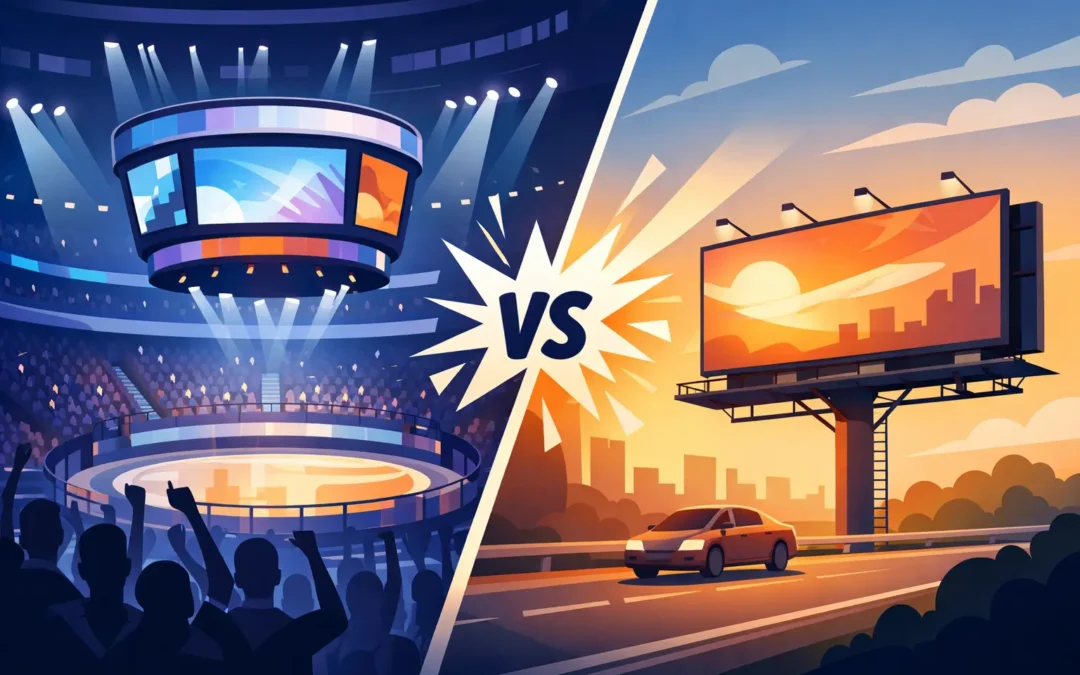
A driver passes a billboard in three seconds. A parent at a hockey rink sits in the building for 90 minutes, often longer, and comes back next week. That is the real starting point in any arena ads vs billboards discussion: not format, but attention.
Both channels are out-of-home. Both can build awareness. Both can play a role in a smart local or regional media plan. But they do not work the same way, and they should not be judged by the same standard. One is built on glance-time. The other is built on dwell time, repeat visits, and community participation.
Arena ads vs billboards: the real difference
Billboards are designed for broad visibility. They sit near roads, collect traffic, and put a brand in front of a large moving audience. The strength is reach at a distance. If the location is strong and the creative is simple, billboards can create useful mental availability.
Arena advertising works differently. It places messaging inside environments where people stay, wait, watch, gather, and return. That changes the value of the impression. You are not catching someone between exits. You are reaching them while they are physically present in a trusted, high-attention setting.
This matters because not all impressions are equal. A media plan can show the same estimated impression count across two channels and still produce very different outcomes. If one impression happens at 45 miles per hour and the other happens while a family sits rinkside, buys snacks, and watches a game, the likelihood of message absorption is not the same.
That is why arena media is often the missing and complementary layer in planning. It adds a form of exposure that most campaigns no longer get enough of – real-world attention in a context people actually care about.
What billboards still do well
Billboards remain useful for a reason. They can create large-scale presence, support geographic coverage, and keep a brand visible in key commuter corridors. For mass-market campaigns, that visibility can still matter.
They are also easy to understand. Buyers know the format. Creative rules are straightforward. The market has long accepted them as a top-of-funnel awareness play.
But billboard strengths come with constraints. The message must be extremely short. The audience is transient. The environment is cluttered. Competing boards, traffic conditions, weather, and route variation all affect what gets seen and what gets remembered.
For local advertisers especially, there is another practical issue: broad traffic is not always qualified traffic. A board may reach thousands of people, but many of them may never become customers. Reach matters, but relevance matters more.
Where arena ads outperform billboards
Arena environments offer something road media cannot: prolonged exposure in a place people chose to be. That creates a stronger relationship between environment, message, and memory.
Arenas and recreation facilities are not passive pass-through spaces. They are recurring community destinations. Families attend games and practices. Adults participate in leagues. Spectators wait, socialize, and look around. That behavior creates natural opportunities for full-screen digital messaging to land.
The difference is not just time on site. It is mindset. In an arena, people are engaged with the setting. They are present. They are part of something. Brands shown in that environment benefit from contextual relevance and trust.
That is especially valuable for categories that depend on local consideration or community credibility: healthcare, real estate, automotive, retail, restaurants, financial services, home services, education, and family entertainment. The ad is not floating past people. It is showing up where real life happens.
Attention quality changes the economics
The phrase arena ads vs billboards often gets framed as a simple reach comparison. That is too narrow.
A better question is this: what kind of attention are you buying?
Billboards are efficient at creating visual presence, but they rely on fragmented moments. Arena ads are built around behavior-driven frequency. The same households often return week after week, sometimes multiple times a week. That repeat exposure is not accidental. It is built into the environment.
For advertisers, this can improve recall without requiring constant creative complexity. A clean message shown repeatedly in a high-dwell venue can outperform a more expensive campaign that gets only fleeting exposure.
For national brands, arena media also solves a common planning gap. Local media has weakened in many markets, but community behavior has not disappeared. People still gather in sports and recreation spaces at scale. Arena advertising turns that behavior into a media asset.
Billboards reach the road. Arena ads reach the routine.
This is where strategy gets more interesting.
Billboards are often best when the goal is market presence. They tell the region your brand exists. They support launches, promotions, and broad reminders. If your objective is to dominate a traffic corridor, they can do that.
Arena ads reach a different layer of decision-making. They sit inside weekly routines. They intersect with family logistics, health habits, after-school schedules, and local spending patterns. That makes them highly effective for brands that want to become familiar, trusted, and top-of-mind within a community.
In other words, billboards can announce. Arena ads can embed.
That distinction matters for businesses trying to drive local action, franchise awareness, or regional brand preference. If your audience includes parents, athletes, active adults, or affluent community-based consumers, arena environments often place you closer to actual purchase behavior.
Creative differences matter too
Billboard creative has one job: communicate instantly. There is little room for nuance. Few words. One visual. Zero dependence on motion or sequence.
Digital arena advertising gives brands more flexibility. Video, motion, rotating creative, seasonal updates, and market-specific messaging are all easier to execute. That does not mean the screen should be overloaded. It means the brand has more ways to stay fresh, relevant, and aligned to the venue audience.
This is particularly useful for advertisers running multiple offers, localized campaigns, or national creative adapted to regional markets. It also makes arena media a strong extension of existing video strategy. If a brand is already investing in video online or on connected TV, arena screens can bring that language into lived experience.
That extension is powerful because it closes a gap. Instead of confining video storytelling to personal screens, it moves the brand into physical environments where people are together, attentive, and receptive.
So which one should advertisers choose?
It depends on the job.
If the goal is broad market visibility and fast recognition across a commuting audience, billboards still make sense. If the goal is stronger attention, repeated exposure, and contextual relevance in community settings, arena ads often work harder.
For many advertisers, this is not an either-or decision. The smartest plans use both, but for different reasons. Billboards can create outer-market presence. Arena media can reinforce the message where participation happens. One builds visibility at scale. The other deepens familiarity where people spend time.
That combination is especially effective when brands want awareness plus local credibility. A commuter sees the brand on the road, then encounters it again inside a trusted venue tied to family, sports, and community life. Repetition across those contexts can strengthen recall and legitimacy.
Still, if budget forces a choice, advertisers should be honest about the audience they actually need. Broad exposure sounds impressive, but wasted exposure is still waste. A narrower channel with better attention and stronger relevance can produce more business value than a larger channel built on fleeting views.
What venue operators should take from the arena ads vs billboards comparison
There is a second audience in this conversation: facility owners and operators.
Billboards monetize roadside real estate. Arena media monetizes interior wall space that already benefits from traffic, dwell time, and repeat visitation. The difference is that arena inventory is part of the experience of the venue itself. It can generate recurring revenue while serving brands that want to be present in the community.
That creates a more integrated value exchange. The venue gains a practical revenue stream. Advertisers gain access to a high-attention environment. The audience sees messaging that is often more locally relevant than what they encounter in many other media channels.
For operators evaluating whether digital ad infrastructure is worth it, the answer often comes down to whether the space has consistent foot traffic and recurring attendance. In sports and recreation settings, that threshold is often already there.
Attention is different inside an arena. People are not just passing by. They are showing up, staying, participating, and returning. That is not a small distinction. It is the reason this channel continues to gain value as advertisers look for media that feels less interruptive and more connected to real behavior.
The billboard still has a role. But if your brand wants to appear where people actually spend time, where families build routines, and where community still has weight, the smarter question may not be which format is bigger. It may be which one people are more likely to remember when it matters.