
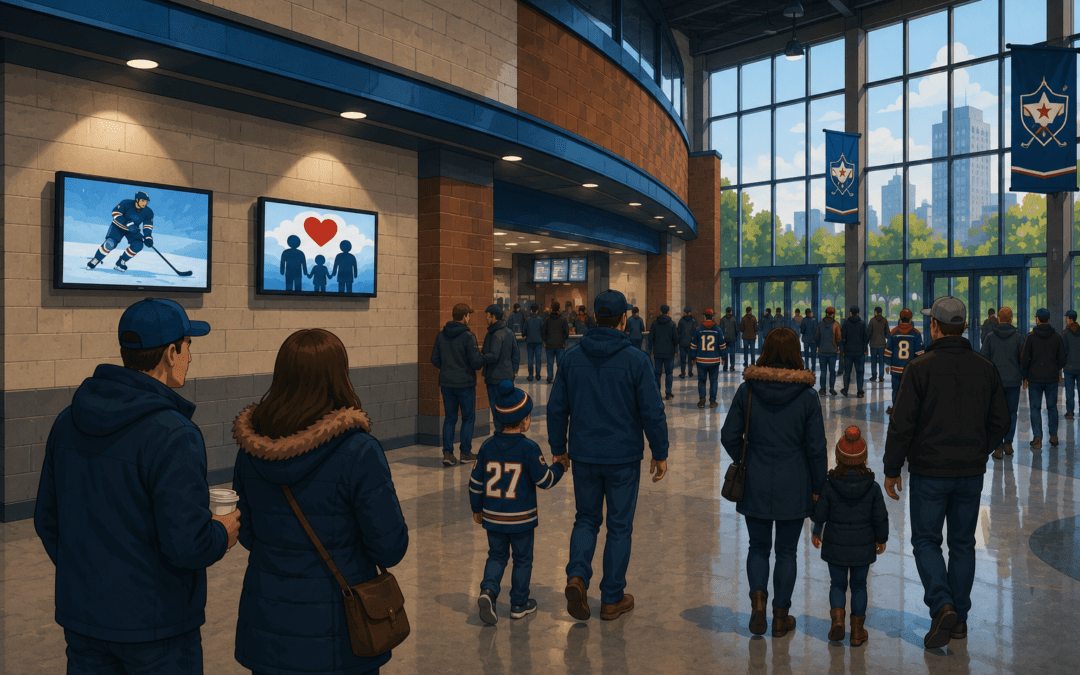
Most media is bought on the assumption that an impression happened. Arena Advertising starts from a better question: was anyone actually paying attention?
Inside arenas and multi-sport facilities, attention behaves differently. People arrive early, stay for extended periods, return weekly, and spend that time in a trusted community setting. They are not speed-scrolling, skipping, muting, or glancing for two seconds at a roadside board. They are present. For brands trying to reach families, active adults, local households, and community-based consumers, that changes the value of the media.
This is why arena environments have become more relevant in a fragmented media market. Local media has thinned out. Consumer attention has splintered. But community participation did not disappear. It simply became more valuable.
What makes arena advertising different
Arena advertising is often misunderstood as just another venue-based placement. It is not. The real advantage is not the screen itself. It is the behavioral setting around it.
Arenas are high-dwell environments. A typical visit can last 90 minutes or more once you include arrival, warm-up, game time, intermissions, and post-game activity. That extended stay creates multiple exposure moments in a single visit. A parent may see a message while entering, again from the stands, again at concessions, and again while waiting for the next session to start.
That pattern matters because repetition inside one environment tends to feel more natural than repetition across intrusive digital formats. The audience is not being chased. The brand is simply present where real life is happening.
The context also does heavy lifting. Arenas are tied to participation, routine, youth sports, recreation, competition, fitness, and community belonging. Brands showing up in that setting borrow some of that relevance. For local businesses, that can mean stronger familiarity. For regional and national advertisers, it can mean a smarter way to show up closer to lived experience rather than just inside a media feed.
Attention quality beats raw impression volume
Reach still matters. Frequency still matters. But not all impressions carry the same weight.
A banner ad served below the fold and a full-screen video spot in a physical venue should not be treated as equal units of media value. One is fighting for a fraction of a second in a cluttered environment. The other appears in a place where people are stationary, waiting, socializing, and repeatedly exposed over time.
That is the strategic case for arena advertising. It is not trying to replace every other channel. It works best as the missing and complementary layer in planning. It extends video beyond the home. It gives local campaigns a physical footprint. It turns sponsorship logic into visible presence. And it adds real-world frequency in places where audiences are known to spend time.
For advertisers dealing with ad fatigue, this matters. Consumers have developed habits that filter out much of digital messaging. They skip pre-roll. They ignore display. They multitask during streaming ads. In an arena, attention is not perfect, but it is materially better because the environment supports viewability, dwell, and repeat exposure.
Why arena audiences are commercially valuable
The arena audience is broader than many media plans assume.
Yes, there are athletes and teams. But there are also parents, grandparents, coaches, spectators, league organizers, volunteers, and active adults moving through the facility week after week. In many communities, arenas and recreation centers are one of the few remaining places where multiple generations gather consistently in person.
That gives advertisers something increasingly rare: concentrated local relevance at scale.
A single venue may represent a defined catchment area. A network of venues creates a stronger media product because it allows a campaign to move from hyperlocal targeting to broader regional or national coverage while staying rooted in the same behavioral logic. That is where the model becomes especially useful for franchises, service businesses, retail groups, QSR brands, automotive, telecom, finance, insurance, health services, and household brands that want to be seen in trusted community environments.
There is also an income and lifestyle layer worth noting. Private sports facilities, recreation hubs, and club environments often index well for active families and established households with regular spending power. That does not mean every arena audience is identical. It means the channel can be planned around venue type, geography, and audience profile in a more intentional way than many buyers expect.
Arena advertising fits how people actually move
People do not live inside channel silos. They move between screens, stores, venues, commutes, and routines. Good planning reflects that.
Arena advertising works because it meets audiences where participation happens. A parent who sees a brand message during a child’s hockey practice may later search for that business, recognize it in-store, or respond more positively when the same campaign appears on mobile or connected TV. The venue exposure does not need to do every job on its own. Often, its role is amplification, credibility, and memory.
That makes it especially effective as an extension layer. If a brand is already investing in video, social, audio, search, or sponsorship, arena placements can strengthen recall by adding physical-world visibility. If a local advertiser has limited budget, the arena can function as a highly visible anchor in the weekly lives of nearby consumers.
The practical point is simple: media performs better when it aligns with behavior. Arena environments are built around repeat visitation and predictable dwell. That is not a small detail. It is the reason the channel works.
What advertisers should evaluate before buying
Not every arena media opportunity is equally valuable. Smart buyers should look past generic claims and ask better questions.
First, how much dwell time does the environment actually create? A venue with heavy traffic but short stays is different from one where visitors remain on site for long stretches. Second, where are the screens positioned? Placement drives viewability. A screen near concessions, waiting areas, or central circulation paths usually delivers more practical exposure than one tucked into a low-traffic corner.
Third, how often does the same audience return? Weekly frequency is one of the strongest advantages in this category. A venue used by leagues, lessons, tournaments, and community programming gives advertisers repeated access to the same households over time.
Fourth, can the network deliver local precision and broader scale? Many campaigns need both. A local orthodontist may care about one venue cluster. A national brand may want consistent execution across multiple markets. The stronger arena networks are built to support both use cases without losing contextual relevance.
Finally, creative matters. Arena advertising is not the place for overcrowded messaging. Clear branding, short copy, strong visual hierarchy, and one obvious takeaway tend to outperform complicated creative. People may see the message multiple times, but each individual exposure should still be easy to process.
The venue partner side of the equation
For venue operators, arena advertising is not only a media story. It is a revenue story.
Arenas, recreation centers, and sports facilities sit on valuable attention that is often under-monetized. Wall space, gathering zones, and common areas already attract traffic. The challenge is operational, not strategic. Most operators do not want to source hardware, manage campaigns, troubleshoot screens, sell inventory, and service advertisers.
That is why the partner model matters. When the network handles installation, management, and sales execution, the venue gains a new recurring revenue stream without adding day-to-day complexity. The advertising becomes an asset rather than a distraction.
There is also a brand experience benefit. Modern digital displays can improve the visual quality of in-venue communications when executed properly. They allow facilities to present community messages, sponsor content, and commercial advertising in a format that feels current and useful rather than cluttered or improvised.
For operators, the trade-off is straightforward. The right partner protects the venue experience, respects the community setting, and delivers monetization without turning the space into visual noise. That balance is where long-term value is created.
Where arena advertising is headed
The market is moving toward media that can prove more than distribution. Buyers want environments that generate actual attention, reflect consumer behavior, and fit into broader planning logic.
That is good news for arena-based media. It sits at the intersection of place, routine, trust, and repetition. It gives advertisers a way to show up in real-world settings that people return to by choice. It gives venue partners a practical way to turn foot traffic into monthly revenue. And it gives media plans something many channels cannot offer anymore: visible presence in community life.
For brands trying to stay relevant beyond the scroll, that is the point. Attention is different here, and that difference is what makes the channel worth buying.
Estimated reading time: 7 minutes