
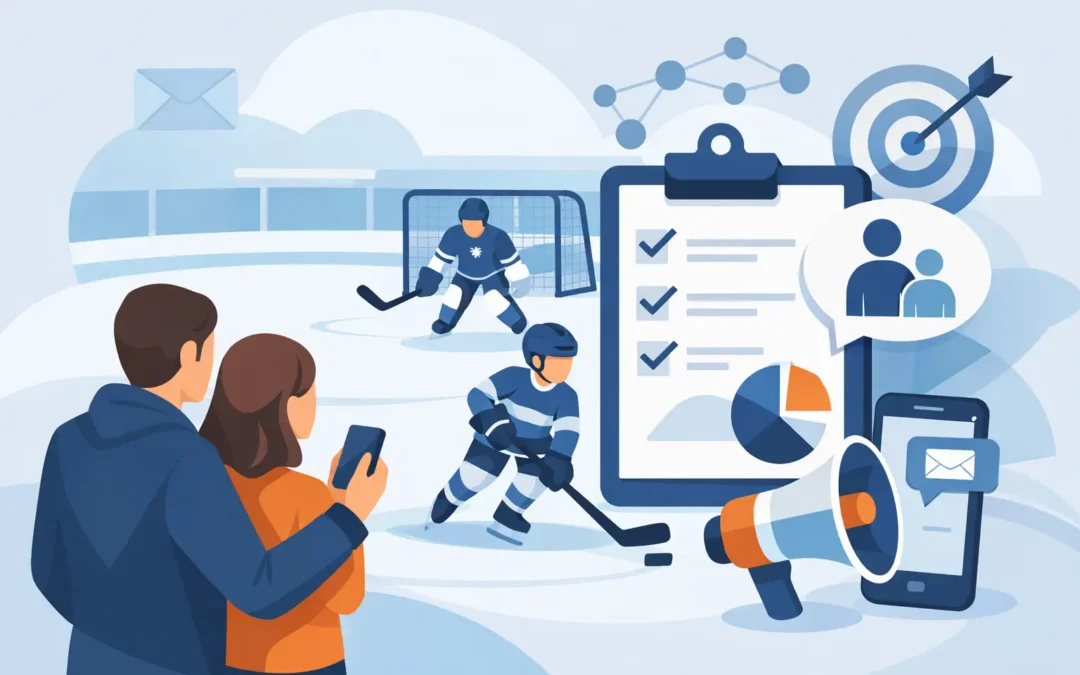
Saturday at 6:10 a.m., the parking lot is already full. One parent is carrying a gear bag bigger than their kid. Another is balancing coffee, a folding chair, and a schedule that runs their entire weekend. If you want to understand how to reach hockey parents, start there – not with a demographic line item, but with the rhythm of their actual lives.
Hockey parents are not casual consumers of community life. They are committed participants in it. They show up early, stay long, return often, and move through the same trusted environments week after week. That makes them valuable, but it also changes how they should be reached. The usual playbook of fragmented digital impressions and passive local media often misses what matters most here: attention quality, timing, and context.
How to Reach Hockey Parents Starts With Behavior
Hockey parents are high-frequency, schedule-driven, and habit-based. Their routines are structured around practices, games, tournaments, team meetings, snack runs, and long stretches of waiting. This is not an audience that drifts in and out. It is an audience that repeatedly occupies the same physical spaces for extended periods.
That distinction matters. A social ad may catch them between tasks. A search ad may catch them when intent is already formed. But the rink catches them in the middle of lived behavior, where family decisions, local spending, and brand familiarity are shaped in real time.
For advertisers, that means the best media strategy is often not about chasing hockey parents across devices. It is about showing up where participation happens. Inside arenas and recreation facilities, they are not scrolling past your message at speed. They are on site for 90 minutes or more, often multiple times per week, in an environment they trust.
This is why context beats raw reach. Hockey parents are not hard to find. They are hard to interrupt meaningfully in the wrong channels.
Why Arenas Work Better Than Generic Local Media
Local media used to provide dependable community reach. That layer has weakened. Attention has splintered across platforms, local news audiences have fragmented, and digital targeting has become noisier and less memorable. Community behavior did not disappear, though. It simply stayed rooted in physical places.
Arenas are one of those places. They are high-dwell environments with repeat visitation and built-in emotional relevance. Parents are there because their kids are there. That creates a different kind of media moment. It is not passive exposure in a disconnected setting. It is brand visibility inside an environment tied to family investment, routine, and trust.
That trust changes how messages land. A financial services brand feels more relevant when parents are actively thinking about youth expenses and family planning. A restaurant, clinic, auto dealer, retailer, or grocery chain feels more useful when the audience is already in motion locally, juggling logistics and nearby purchase decisions.
The media value is not just that parents see the message. It is that they see it in a place that reflects how they actually live.
The Best Message Depends on What You Sell
Not every advertiser should approach hockey parents the same way. A local pizza brand can lean into immediate utility. A regional healthcare provider may want to build trust and top-of-mind awareness. A national CPG brand may be less concerned with direct response and more focused on repeated exposure in family-heavy environments.
That is the trade-off. If you are selling something time-sensitive or location-driven, proximity and repetition matter most. If you are building broader brand preference, the advantage is sustained visibility in a context that reinforces credibility. In both cases, the environment does some of the work for you.
Creative should reflect that. Hockey parents do not need abstract brand theater at 7 a.m. in a cold rink lobby. They respond to clarity, relevance, and recognition. Strong creative in this setting is simple, visible, and immediately legible. It respects the environment instead of fighting it.
Video can be especially effective because motion naturally holds attention in otherwise static spaces. But the bar is not cinematic storytelling. The bar is clear communication with enough frequency to become familiar.
How to Reach Hockey Parents Without Wasting Impressions
A common mistake is treating hockey parents as a broad “family audience” and buying media accordingly. That usually creates spill, weak context, and low recall. Hockey parents are better approached as a behavior-defined segment. They are not just parents. They are recurring visitors to specific facilities, at predictable times, in a concentrated mindset.
That is where place-based media has an advantage. Instead of paying for impressions spread across mixed-intent audiences, brands can concentrate visibility inside environments where this segment naturally over-indexes. The result is less wasted delivery and more situational relevance.
It also creates stronger frequency. One exposure rarely changes anything. Ten exposures across a season, in the same real-world setting, begins to build memory. That is especially valuable for categories where the decision window is not immediate. Home services, financial products, healthcare, automotive, insurance, and retail all benefit from being remembered before the need becomes urgent.
This is one reason arena-based media works as both a stand-alone channel and a complementary layer in broader planning. It does not replace digital, search, social, or sponsorship. It strengthens them by extending brand presence into the physical environments where community participation actually happens.
What Hockey Parents Notice in the Real World
Parents in rink environments are filtering a lot at once. They are managing time, kids, schedules, and constant movement. So the media that cuts through is not the loudest. It is the most aligned.
They notice brands that feel useful, local, and familiar. They notice messages that appear repeatedly without becoming intrusive. They notice businesses that seem to understand the setting they are in.
That has practical implications. Hyper-local offers can work well, but only if the brand can fulfill them nearby. Broad national awareness campaigns can also work, but they should still respect the environment by showing relevance to active families, wellness, mobility, food, finance, or everyday household decision-making.
There is also a seasonal layer. Back-to-school, winter driving, flu season, tournaments, holidays, and spring registration windows all shape parent attention differently. Smart planning accounts for those moments instead of treating the hockey audience as static year-round.
The Question Is Not Reach Alone
When marketers ask how to reach hockey parents, they are often really asking how to influence a high-value community audience without getting ignored. Those are not the same question.
You can technically reach hockey parents in dozens of channels. You can target them online, sponsor teams, buy radio, run social, or build local partnerships. Each has a role. But if the goal is sustained visibility in a trusted, high-attention environment, the rink has a distinct advantage.
It combines audience concentration, repeat exposure, emotional relevance, and real-world dwell time in a way most channels cannot. That is why it performs well not just as awareness media, but as memory media. It stays with people because it appears where their routines are real.
For local advertisers, that can mean stronger community presence without overcomplicating the plan. For national brands, it offers local relevance at scale across a consistent environment. For both, it is a way to move from passive media consumption to contextual brand participation.
Networks such as SDN are built around that exact idea: extending video into lived experience where attention is different and community behavior is measurable.
The smart play is to stop treating hockey parents like a hard-to-catch digital segment and start treating them like what they are – one of the most visible, routine-driven, and context-rich audiences in community media. Show up where their weekends happen, and your message has a far better chance of being remembered on Monday.
Estimated reading time: 6 minutes