
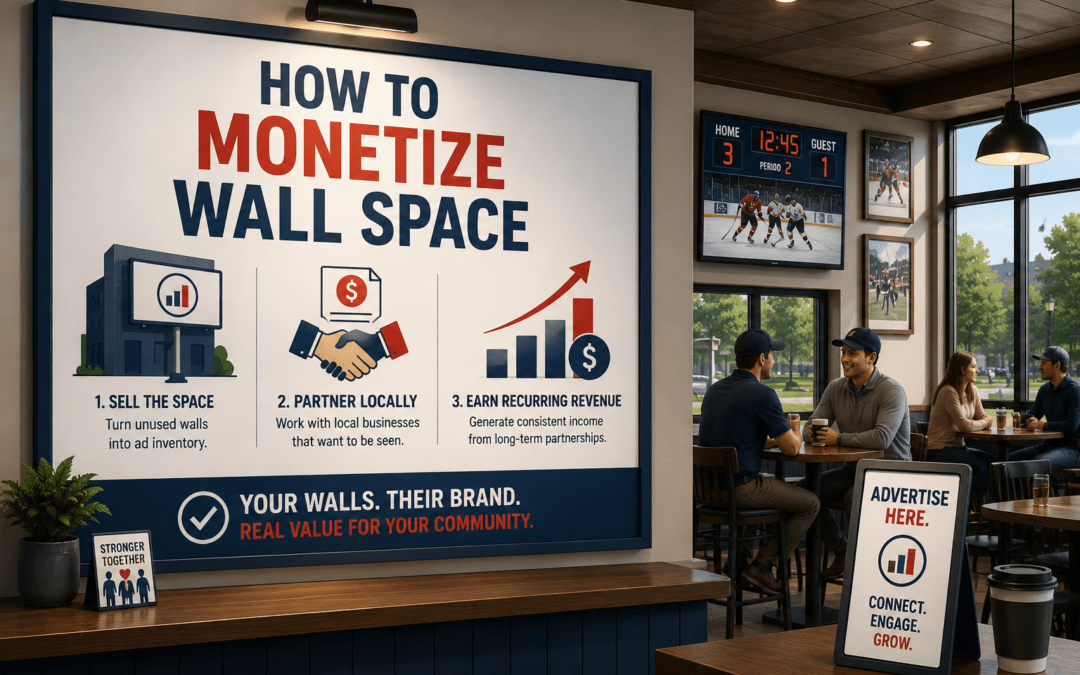
A blank wall inside a busy venue is rarely just a wall. In the right environment, it is repeat exposure, local relevance, and monthly revenue hiding in plain sight. That is the real answer to how to monetize wall space – not by filling space for the sake of it, but by turning high-traffic, high-dwell areas into media that people actually notice.
For venue operators, that means looking beyond posters, sponsor boards, or one-off signage deals. For advertisers, it means recognizing that the most effective media often shows up where people are present, waiting, watching, and participating. The wall matters less than the behavior around it.
How to monetize wall space starts with attention
Not all square footage has media value. A hallway no one lingers in behaves very differently from a lobby outside the ice, a viewing area in a multi-sport facility, or a member lounge in a private club. If people move through a space quickly, your wall has limited value. If they return weekly and stay for 60, 90, or 120 minutes, the equation changes.
That is why the best wall-space monetization strategy starts with attention, not hardware. Screens are easy to buy. Real-world attention is harder to find. Facilities that host sports, recreation, and community routines tend to have a natural advantage because the audience is not just passing through. They are invested in the environment. They are waiting for a game to start, watching a child practice, meeting other families, or spending time between activities.
That kind of dwell time creates something digital channels struggle to replicate – repeated visibility in a trusted setting. People may ignore a social ad in half a second. They are less likely to ignore a well-placed screen in a venue they visit every week.
The wall only performs if the environment does
This is where many venue owners get the model wrong. They assume any monitor mounted on any wall can generate ad revenue. It usually does not work that way.
Advertisers buy context as much as placement. They want access to real audiences in environments that match their category, geography, and goals. A local dental practice may want consistent reach among families in one trade area. A national CPG brand may want scaled frequency across multiple active-lifestyle venues. A golf-adjacent brand may care more about member demographics than raw foot traffic.
So if you are evaluating how to monetize wall space, ask a better question first: who is here, how often do they come back, and how long do they stay? A facility with lower traffic but strong audience fit can outperform a busier site with weak relevance.
Static signage can generate revenue. Digital does more.
Static signage still has a place, especially for permanent sponsors or long-term naming-rights relationships. It is simple, familiar, and sometimes effective. But it has limits. One wall can only hold so many signs before the environment starts to look cluttered, dated, or easy to tune out.
Digital changes the economics. A single full-screen display can rotate multiple advertisers, support motion and video, and update creative without reprinting anything. That expands inventory without covering every surface in the building. It also creates a cleaner experience for the venue and a better storytelling format for brands.
More importantly, digital wall media can serve two objectives at once. It can create recurring revenue for the venue while giving advertisers a format that extends beyond traditional online video. Instead of competing for skipped impressions, brands can show up in lived experience – where sports, family routines, and community participation are already happening.
How to monetize wall space without creating operational headaches
This is usually the tipping point for venue partners. The revenue opportunity sounds attractive until the practical questions show up.
Who pays for the screen? Who installs it? Who sells the ads? Who updates the content? Who troubleshoots the hardware? Who makes sure the creative feels appropriate for the environment?
If the venue has to build that capability from scratch, the model gets heavy fast. Managing screens is one business. Running a media network is another. Most operators do not want to become signage managers, ad sales reps, and tech support teams on top of running a facility.
That is why outsourced or partner-led models tend to make more sense in community venues. The strongest approach is usually one where the operator contributes the wall, the audience, and the environment, while a media partner handles installation, advertiser demand, campaign management, and network execution. The venue gets recurring income without taking on a second business.
That trade-off matters. Self-managing may offer more control, but it also brings more friction and slower monetization. A managed model reduces control over every detail, yet often produces better fill rates and less operational drag.
The best inventory is built around behavior
A screen by itself does not create value. Placement does.
The highest-performing wall locations are typically tied to moments of natural pause. Entry points, concession waiting areas, central lobbies, rink-side viewing zones, check-in corridors, and social spaces tend to outperform transitional corners or walls people face for only a second. The question is never just whether a wall is visible. It is whether people have a reason to look up.
This is where sports and recreation venues are different from many other place-based environments. The audience is not there to rush through an errand. They are there to participate, watch, wait, and return. That creates behavior-driven frequency, which is what advertisers actually want when they are trying to build familiarity over time.
One visit matters. Weekly repetition matters more.
Revenue depends on who you sell to
There are usually two paths when monetizing venue wall space: local demand and network demand.
Local demand comes from businesses that want to reach a defined community audience close to where they operate. Think healthcare, restaurants, retail, real estate, automotive, financial services, youth programs, or home services. These advertisers care about proximity and trust. A strong local venue can be a credible media environment because it sits inside community life rather than beside it.
Network demand comes from regional and national brands that want consistency across multiple venues. They are less interested in one wall and more interested in a scalable footprint with comparable audience quality. For them, the appeal is local relevance at national scale.
The smartest monetization models usually involve both. Local advertisers bring contextual fit. Larger brands bring scale, repeat budgets, and campaign consistency. A network like SDN is built around that exact overlap – helping venues convert high-attention wall space into recurring media revenue while giving brands access to audiences in trusted real-world environments.
Measuring wall-space value the right way
The easiest mistake is to price based on screen ownership instead of audience value. Advertisers do not care that a display is expensive. They care whether it puts their message in front of the right people often enough to matter.
That means valuation should be grounded in practical media logic: weekly traffic, average dwell time, repeat visitation, audience profile, and the quality of the placement inside the venue. A screen in a high-dwell family sports environment can be more valuable than a more prominent-looking placement in a low-attention setting.
Measurement does not need to be overly technical to be credible. In fact, simple proof points often work best. How many people visit annually? How long do they stay? How often do they return? Is the screen full-motion and full-screen? Is the environment trusted and brand-safe? These are the metrics that help advertisers understand the difference between passive exposure and real-world attention.
When wall-space monetization is not the right fit
It depends on the venue. If traffic is inconsistent, audience quality is unclear, or the wall is located in a low-visibility area, monetization may underperform. The same goes for facilities that want full control over every ad but do not have the sales infrastructure to fill inventory consistently.
There is also a brand experience consideration. Too many screens, poor placement, weak creative, or irrelevant advertisers can make a venue feel over-commercialized. Good monetization should feel integrated, not intrusive. The media should reflect the environment rather than fight with it.
That is why selective deployment matters more than volume. One strong screen in the right location can outperform several mediocre placements.
What advertisers should take from this
If you are a marketer, wall space is not interesting because it is physical. It is interesting because of what happens around it. Community venues concentrate routine, trust, and attention in a way many channels no longer do. That makes them a strong complementary layer in planning, especially for brands trying to extend video into real-world moments.
And if you are a venue operator, the opportunity is larger than signage revenue. Done well, monetized wall space becomes a recurring media asset built around the audience you already have. You are not forcing advertising into the building. You are organizing visibility around real behavior.
The best walls do not just hold a screen. They hold attention long enough to make the message count.
Estimated reading time: 7 minutes